





MPN
Latest News

Advertisement
Latest Videos







Advertisement
More News

Childbirth rates have been reduced by 22% in women with MPNs, compared with women without MPNs, researchers found.

Treatment with rusfertide led to a decrease in the need for blood draws and decreased levels of red blood cells in patients with polycythemia vera.

Patients with myeloproliferative neoplasms should keep their care team up to date on any symptoms they’re experiencing, an expert said.

Patients with MPNs who are JAK2V617F- and CALR-positive had different bacterial compositions compared with people without MPNs, research found.

The year 2024 is now underway. After a busy 2023, we’re now looking back at some of the oncology headlines from the new year.

Thomas Silver discusses how a community of support helped a patient when his bone marrow transplant was delayed.

A doctor reflected on what it was like treating patients with myeloproliferative neoplasms years ago and how much treatments have improved.

New treatments and ongoing trials are providing more options and better outcomes for patients with myeloproliferative neoplasms, an expert explained.

Dr. Douglas Tremblay of the Ichan School of Medicine explains the necessity of cytoreductive therapy for patients with MPNs such as essential thrombocythemia and polycythemia vera.

For patients with myeloproliferative neoplasms, it is essential to have an open relationship with oncology nurses, an expert explained.

Dr. Lucia Masarova sat down with CURE® and discussed the advancements she hopes to see in 2024 for the treatment of patients with myeloproliferative neoplasms.

The three-year final analysis of efficacy and safety of the REACH3 trial showed that patients with steroid-refractory or dependent chronic graft-versus-host disease benefited more with Jakafi compared with the best available treatment.

The recent phase 3 TRANSFORM-1 study concluded that navitoclax combined with Jakafi showed significant spleen volume reductions in patients with myelofibrosis.

One expert explained how care team aspects such as open dialogue, support and validation can help to inform patients with MPN about psychosocial needs that tend to be unmet.
Amanda Smith, a registered nurse with Huntsman Cancer Institute, explained the impact early satiety can have on patients with MPNs and why communication with their care team is important.

The FDA approved Ojjaara for intermediate or high-risk myelofibrosis, including primary myelofibrosis or secondary myelofibrosis (post-polycythaemia vera and post-essential thrombocythaemia), in adults with anemia.

Myelofibrosis-related anemia is different than anemia experienced by patients without a cancer diagnosis, a research nurse explained.

Nurse practitioner Charina Toste explains why it is important for patients to be empowered to have educated conversation with their care teams.

Reporting MPN side effects to the care team, regardless of how “little” they may seem, can help determine how to adjust treatment to address these symptoms, an expert said.

We took a look back at the most noteworthy and compelling myeloprolifearative neoplasm stories from 2023.
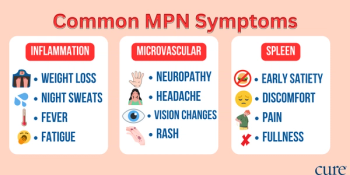
Patients with MPNs can potentially experience long asymptomatic periods, and it’s up to patients and providers to remain vigilant as they monitor and manage symptoms.
This particular designation may expedite the process of approving Xpovio for the treatment of patients with myelofibrosis to address an unmet medical need.

Disease symptoms, as well as other health conditions, can have a major impact on the treatment plan for patients with myeloproliferative neoplasms.

Jaktinib significantly improved spleen volume reduction rates compared with hydroxyurea in intermediate- to high-risk myelofibrosis.

Watch Dr. Jerry Spivak, from Johns Hopkins University School of Medicine, discuss what is on the horizon in the management of polycythemia vera during the CURE® Educated Patient® MPN Summit.
Advertisement
Advertisement
Trending on CURE
1
Stage 4 Breast Cancer: How a Second Opinion Saved Her Life
2
Psycho-Oncologist Answers 5 Common Questions About the Emotional Impact of Cancer
3
How a Cancer Survivor Learned to Stop Hiding His Surgical Scars
4
FDA Flags Possible Colitis Risk With CDK4/6 Breast Cancer Drugs
5