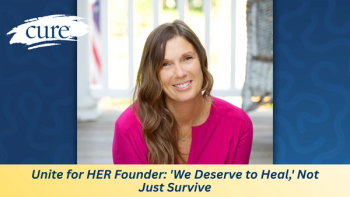
Sue Weldon, a 22-year breast cancer survivor and Unite for HER founder, explains how integrative therapies helped her heal after chemotherapy.
After 17 and a half years with metastatic primary peritoneal cancer, a former hospital executive explains how an AI health agent helped her after discharge.
Jane Loeb Rubin has been a cancer survivor for close to 28 years. She was diagnosed with breast cancer in her 40s and, 10 years later, with primary peritoneal cancer, which she has lived with for 17 and a half years.
Rubin, 72, spent her career in health care, including overseeing neuroscience services in a five-hospital system, and later became a historical fiction writer. In an interview with CURE, she discussed how she copes with metastatic cancer, what being a patient taught her as a former administrator and how an artificial intelligence (AI) health agent helped her at home after a hospital stay this summer. The tool, called AiME, is part of the post-discharge care offered by Dimer Health, a company co-founded by Rubin's daughter, Caroline Hodge.
This interview has been edited for length and clarity.
Rubin: I was diagnosed in 2009, almost as an incidental finding. I was getting a cardiac scoring test, and the radiologist noticed something on my peritoneal wall. It turned out to be ovarian cancer. There's a 4% risk that ovarian cancer will present that way, but when it does, it's immediately metastatic because it's outside of the primary organ.
So I began a very lengthy journey of one treatment after another. [There were] some very conventional treatments in the beginning, and then a number of new discoveries in the cancer field led me to [a] group of [drugs called] PARP inhibitors. Now I am on another new drug. I've gotten one treatment so far and [have] been feeling pretty good. The fact that I'm still here is pretty remarkable. It has a lot to do with the advancements in drug therapy, targeted therapy [and] understanding our genes.
Probably the most difficult times have been when I've had to be hospitalized and then come home. I find that free fall really tough. I've been hospitalized for half a dozen major surgeries, and sometimes I'll get a bowel obstruction, and it'll be bad enough that I have to be admitted. When I get home, I don't feel sure-footed, and it's usually weeks before my next doctor's appointment. That's when I start getting nervous.
[Before Dimer,] I had to have a couple of cardiac stents put in, and the nurse gave the discharge instructions so fast that my head was still foggy. When I went home, I started having a slow hemorrhage from the site where they put the catheter in. I went to work and walked into my stroke nurses' office, and they [told me I was] hemorrhaging. If it weren't for the fact that I worked in the hospital, I could have gotten into a lot of trouble at home.
Another time, after one of my surgeries, the nurse forgot to change my dressing, so I went home with a soiled dressing all the way down the middle of my belly. My kids are all in health care, and they came over, and I said, "Can you just look at this?" If I had been on my own and didn't have access to personal connections, I might have had a postoperative infection. It usually takes a couple weeks to get in to see your doctor, so it's really important to have eyeballs on your wounds earlier than that.
A live practitioner [met with me virtually], and at the end of the call, she explained to me how to use AiME. She suggested I practice and use AiME to ask about a diet that I could handle, so I did, and then I started using AiME more. It's like a call button. When you're in a hospital bed and you need the nurse, you press the button. They have something very similar on the website, so I was able to go to the website, call AiME and present my questions. It didn't take up people's time, although the provider was always available, also.
When I went into the hospital this summer, I had a spontaneous inflammation of my intestines. Nobody knew what caused it, whether it was a reaction to my latest chemo or if I had just gotten back from a trip abroad and eaten something that really disagreed with me, so I was afraid to eat. I didn't know if I should be eating mashed potatoes for every meal. The last thing I wanted to do was throw my body into that kind of pain again, because it was really severe.
I got the answers I needed between AiME for a general diet, and then one of the providers came on and we talked about it some more face to face. I was so encouraged and relieved. If I didn't have those resources, I don't know where I would have gone for those answers.
Because of the condition of my kidneys, I can't take drugs like Advil [ibuprofen]. I have to take Tylenol [acetaminophen], which is a different class. I didn't realize that, so I checked with AiME, and sure enough, AiME checked my medical record and said Tylenol only. Medication errors are huge in [patients after discharge].
The best lesson for any doctor or administrator, and I include the [physician assistants or nurse practitioners], is what they learn from being a patient, because so many decisions are made in a hospital by pretty healthy people. When I wanted to test drive a new procedure, I'd use administrators, including the finance people, as guinea pigs because they never saw a sick person. When they had to lie prone on a hospital gurney, you could see they were getting nervous, and it was good. It's just totally different when you're feeling great.
It's changed a lot over time, and it can change a lot even in the course of a day, depending on if it's a treatment day or a writing day for me. Years ago, a rabbi told me [something that] was like the Serenity Prayer. I should do everything I could within my control, and then I should put the rest of my fears in this box and put the lid on it, because it was stuff I couldn't change, and I needed to just live. I have taken that message to heart and have traveled extensively with my husband and lived a beautiful life.
We have all kinds of mantras in my house. It's like a tightrope walker. Just focus on the other side of the tightrope. You'll be there tomorrow. The surgery will be over. It'll be behind you. You never know how much life you're going to have, and to spend it wringing your hands is such a waste, and it's so unfair. So I really try hard to encourage people to live their best life.
For more news on cancer updates, research and education,