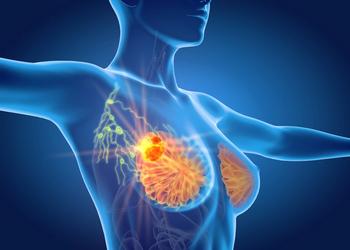
The FDA has cleared TumorSight Risk, software that uses a patient's existing breast MRI, pathology and clinical information to estimate the chance that early HR-positive, HER2-negative breast cancer will come back within five and 10 years.
AI is changing breast cancer screening, helping doctors detect cancer and predict future risk. Learn what AI mammography means for patients.
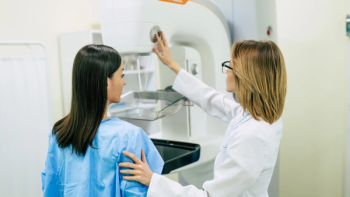
Artificial intelligence (AI) has been helping doctors find breast cancer on mammograms for years. Now, it may be able to do something different: help predict who is more likely to develop breast cancer in the future.
That shift was recognized in the 2026 breast cancer screening guidelines from the National Comprehensive Cancer Network (NCCN), which now include AI-based risk prediction from a standard mammogram.
For patients, that could mean your mammogram provides more information than simply whether cancer is present today.
There are two main ways AI is being used in breast imaging.
Detection AI : looks for signs of cancer that may already be present. It can flag suspicious areas, such as masses or calcifications, for a radiologist to review.
Risk-prediction AI : looks at a mammogram differently. Instead of searching for cancer that is already there, it analyzes patterns in the breast tissue that may be linked to developing breast cancer in the next several years. The NCCN update focuses on this second use.
Doctors have traditionally estimated breast cancer risk using factors such as age, family history, genetics and reproductive history. But many women who develop breast cancer don't have a strong family history or a known genetic mutation.
AI offers another potential source of information: the mammogram itself.
The AI model referenced in the updated NCCN guidelines analyzes a standard mammogram and provides an estimated five-year breast cancer risk.
Under the updated guidance, a five-year AI-calculated risk of 1.7% or higher is considered increased risk. This doesn't mean someone has cancer or that they will definitely develop it. Instead, it may prompt a conversation about whether additional screening or risk-reduction strategies make sense.
Depending on a person's overall risk, those discussions could include:
The technology uses a type of AI called deep learning. It was trained using large numbers of mammograms from women who did and did not later develop breast cancer.
Rather than looking for one specific abnormality, the AI identifies subtle patterns in breast tissue that may be associated with future breast cancer risk.
The result is a percentage estimating the chance of developing breast cancer within five years.
But there is an important limitation: AI doesn't always explain exactly why it gives someone a particular score. Researchers are still working to understand what specific patterns the technology is identifying.
The use of AI in mammography is part of a much bigger shift happening across health care.
Doctors and researchers are increasingly studying and using AI to analyze medical images, identify patterns in patient data, predict health risks and support treatment decisions.
In cancer care, AI is being explored in areas including imaging, pathology, treatment planning and clinical research. As these technologies improve, they could help doctors detect cancer earlier, better understand a patient's individual risk and identify treatments that may be more likely to work.
For patients, the goal isn't to replace doctors. It's to give health care teams more information to help them make better-informed decisions.
But AI also comes with questions. Researchers are still studying how accurate these tools are across different groups of patients, how they should be used alongside a doctor's judgment and how to make sure they don't introduce or reinforce existing biases in health care.
That means AI is best viewed as another tool in the care team's toolbox — not a replacement for the people providing your care.
You don't need a separate test to use this technology. If your health system offers an FDA-authorized AI risk tool, it can analyze the mammogram you're already having.
If you're interested, ask your breast imaging team whether AI-based risk assessment is available.
Most importantly, an AI risk score is not a diagnosis. A higher score doesn't mean you have cancer or that you will definitely develop it. It simply gives you and your health care team another piece of information that may help guide your screening plan.
AI is still being studied, including whether using these risk scores to recommend additional imaging actually improves outcomes. As research continues, your mammogram may become useful for more than finding cancer today — it could also help doctors better understand your risk for tomorrow.
For more news on cancer updates, research and education,