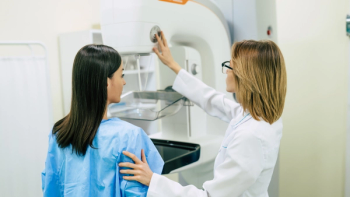
In a randomized trial of nearly 100,000 women in Germany, 3D mammography found a larger share of breast cancers at the screening visit, but its 24% lower rate of cancers found between screenings was not statistically significant.
The FDA has cleared TumorSight Risk, software that uses a patient's existing breast MRI, pathology and clinical information to estimate the chance that early HR-positive, HER2-negative breast cancer will come back within five and 10 years.
The U.S. Food and Drug Administration (FDA) has cleared TumorSight Risk, an artificial intelligence (AI) software tool that estimates how likely early-stage breast cancer is to come back, its maker, SimBioSys, announced on Oct. 15, 2026. The tool is meant for adult women with hormone receptor (HR)-positive, HER2-negative breast cancer that is stage 1 through stage 3A.
The clearance came through the FDA's 510(k) pathway, which is used for medical devices, including software, that the agency finds substantially equivalent to a device already on the market. It is not a drug, and it does not treat cancer. Instead, it adds another piece of information that patients and their doctors can weigh when planning care.
TumorSight Risk is cleared for adult women whose breast cancer is HR-positive (the cancer cells use the hormones estrogen and/or progesterone to grow) and HER2-negative (the cells do not make extra amounts of a growth protein called HER2). This is the most common type of breast cancer. The tool is intended for cancers that have not spread beyond the breast and nearby lymph nodes, stage 1 through 3A.
The software analyzes information that is already collected during routine care: a breast MRI (magnetic resonance imaging) scan, the pathology report from the tumor tissue and clinical details. According to the company, it requires no additional procedure, no shipping of tissue to a lab and no special equipment, and the result can be available before surgery.
The tool produces a score from 0 to 100, places the cancer in a high-, intermediate- or low-risk group and gives an individual estimate of recurrence-free survival (the chance of living without the cancer coming back) at five and 10 years. The FDA-cleared intended use says the result should be considered alongside other clinical and pathology factors, not on its own.
The clearance is supported by a study of 2,129 patients treated at Mayo Clinic, Emory University, Stanford Medicine and Mercy Medical Cedar Rapids. Researchers designed the study in advance and kept the analysis blinded, but it looked back at patients who had already been treated rather than following new patients forward. The results were presented at the 2026 American Society of Clinical Oncology (ASCO) Annual Meeting.
Because the tool uses a breast MRI and pathology results that are already part of many patients' workups, it does not add a procedure, a blood draw or a biopsy. It does not change what treatment a person receives on its own. Not every patient with early breast cancer has a breast MRI, however, so the tool will not apply to everyone.
The company’s announcement did not say when the tool will be widely available or how much it will cost, and it did not address insurance coverage. The study looked back at past patients, so it did not test whether using the score to guide treatment leads to better outcomes. The announcement also did not compare TumorSight Risk with the genomic tests doctors already use to estimate recurrence risk in HR-positive breast cancer. According to the company, Mayo Clinic, one of the study sites, has a financial interest in SimBioSys.
Doctors already have several ways to estimate recurrence risk in this type of breast cancer, including tumor size, lymph node involvement, grade and
If you have been diagnosed with early HR-positive, HER2-negative breast cancer, this clearance means there is now an FDA-cleared, MRI-based option for estimating your risk of recurrence. It is one more source of information, not a replacement for the factors your care team already considers. Treatment decisions, such as whether chemotherapy adds benefit to hormone therapy, still rest on the full picture of your cancer and your preferences.
For more news on cancer updates, research and education,