Debbie Legault, whose daughter was diagnosed with breast cancer at 27, urges shoppers to skip pink ribbon products and donate directly to support organizations.
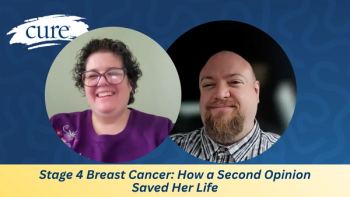
Eileen Carter was told she had two to three years to live after a stage 4 breast cancer diagnosis. A second opinion changed her care.
When Eileen Carter felt a lump in her armpit in February 2025, she was five or six months pregnant with her first child. Doctors told her it was most likely benign, probably her body adjusting to the pregnancy.
Weeks later, a mass in her breast kept growing until it was more than half the size of her breast. Her obstetrician said it was probably mastitis, an inflammation of breast tissue, because she was so close to giving birth.
“Being first-time parents, we had no idea what was going on, so I just went with it,” said Eileen, a 43-year-old former preschool teacher from Hamilton, New Jersey. “I was very much dismissed, but we’re not doctors.”
Five weeks after her daughter, Rebekah, was born, Eileen was diagnosed with stage 3 invasive ductal carcinoma. Two weeks later, the diagnosis changed to stage 4. She was told she had two to three years to live and that standard treatment and surgery were not options.
After Eileen gave birth, she couldn’t breastfeed on one side, and the nipple was inverted. The day after delivery, she had ultrasounds in her hospital bed. Doctors still said the mass was probably edema or a benign growth.
“They couldn’t even define the mass, but one doctor said, ‘Why don’t we just get a biopsy, just in case?’” she said.
That biopsy led to her diagnosis at the end of July 2025.
Eileen said she has little memory of the weeks that followed. She described being postpartum, learning to care for a newborn and facing a cancer diagnosis all at once.
“My brain was on autopilot,” she said. “I just made sure she was fed, she was clean and she was happy. They always say one day at a time. I was going one hour at a time.”
Rebekah became her focus. “Her smiles, her learning, her tiny growth cheered us up when we needed it,” Eileen said.
Her husband, Jeffrey Carter, is a clinical chaplain for Hackensack Meridian Health (HMH) Hospice and supports people at the end of life. When Eileen’s diagnosis changed to stage 4, he recognized a shift in how her care team talked about her treatment.
“They switched their language from curative to palliative,” Jeff said. “From my experience, I could tell this was a change and they weren’t positive. … We needed to find someone who was actually going to try.”
He described those early weeks as “walking through a tub of maple syrup.”
“But you push on, and if you can find the right person and team who are willing to give you a hand and help pull you through, it makes all the difference,” he said.
Jeff’s coworkers urged the couple to get a second opinion. Eileen had already noticed something that didn’t match her prognosis: After three weeks of chemotherapy, she could physically feel the mass shrinking.
“When they gave me two to three years, I had only had three treatments, and things were getting better,” she said. “So I thought, why are we here?”
The couple sought opinions at two other centers. They ultimately moved her care to HMH Jersey Shore University Medical Center. According to the health system, chemotherapy shrank the tumor in her breast by 90%, so a planned procedure on her liver was no longer needed. A double mastectomy in March 2026 found no viable cancer remaining.
Eileen now encourages others to seek another opinion, even when they are happy with their care.
“Even if you love your doctors, it doesn’t hurt to get a second opinion,” she said. “If you get one and you still like where you are, you’ve validated that you tried everything you possibly can.”
Jeff agreed. “Either it will validate that your doctor is good, or it will give you better insight,” he said.
Eileen received chemotherapy once a week for 12 weeks, then once every three weeks for 12 weeks. Her mother and aunt cared for Rebekah during treatment, and her father went with her to every appointment. Living next door to her parents made drop-offs easy.
“A friend of mine labeled them our ‘prayer army,’” Eileen said. “It wasn’t just Jeff, me and Rebekah. It was my parents, his parents, our friends, our family, our neighbors. We did it together.”
For Jeff, caregiving blurred the line between work and home.
“I went from patients at work to a patient at home,” he said. “I would have loved to come home and just break down into tears sometimes, but Eileen needed to talk about something, or there were treatment options to discuss.”
He credited his faith, his fellow chaplains, the nurses and staff at work and his family with getting him through.
His advice to partners is to listen, including to what goes unsaid.
“Even surrounded by support, you still feel like you’re by yourself, because you’re the one going through it,” Jeff said. Sometimes Eileen needed his help. “Other times, Eileen needed to be caring for our child, because it gave her a sense of accomplishment and purpose,” he said.
Caregivers also need their own outlets, he added: “You have to have people to go to, people to talk to and things to do that give you an opportunity to be strong when there’s very little downtime.”
Today, Eileen receives Keytruda (pembrolizumab) every three weeks. She also goes to weekly physical therapy to help prevent lymphedema, swelling that can occur after lymph nodes are removed. She has scans every three months, alternating between CT and MRI.
“I’m achy, and every once in a while, I get really tired,” she said. “I’m slowly getting my stamina back, which is wonderful. I feel like I can accomplish things around the house again.”
Eileen said one of the biggest sources of comfort was talking with a woman in California a few months ahead of her in treatment.
“You can be surrounded by so much love and still feel incredibly alone,” she said. “Having somebody who can say, ‘It’s OK to feel that way. That’s normal. That’s what I felt as well’ — it truly changes everything.”
Jeff said people often call his wife strong. She responds with a bewildered look.
“She says, ‘I had a daughter. What else was I supposed to do?’” he said. “You have to have support, you have to have focus and you have to know that even when there seems to be no hope, there’s always a next step. It’s just hard to see.”
For more news on cancer updates, research and education,