
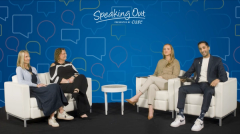
Opinion|Videos|July 28, 2026
Lung Cancer Research Advances: New Targeted Therapies and Hope for Patients
When Lisa Spain started Rexana's Foundation in 2006 after losing her closest friend to lung cancer just 60 days after diagnosis, the treatment landscape looked dramatically different than it does today.
Advertisement
Episodes in this series
When Lisa Spain started Rexana's Foundation in 2006 after losing her closest friend to lung cancer just 60 days after diagnosis, the treatment landscape looked dramatically different than it does today. Options were few. Targeted therapy was in its early stages. The idea that a patient might take a daily pill, avoid chemotherapy entirely, and live with their cancer controlled for years was not yet a reality.
Twenty years later, it is.
"I can remember going to conferences in the early 2000s and it was crickets," Spain said. "Oh my goodness. And then to go to the recent conferences — it's headlines everywhere. Lung cancer and the progress. I'm just wanting to do the little happy dance."
A New Generation of Targeted Therapies
Dr. Bruna Pellini, chief of thoracic medical oncology at Baptist Health Herbert Wertheim Cancer Institute, describes the evolution of targeted therapies in terms of generations — each new wave of drugs designed to be more precise, more effective, and less toxic than the one before.
For patients with certain targetable mutations, including ROS1 fusions, she says the field now has what she would call a fourth generation of drugs. "I remember when I was in training, we did not have many options. We had one option. And now you have at least four drugs, potentially five, depending on the setting," she said.
The newest agents are showing results that were unthinkable even a few years ago. Pellini highlighted a recent drug approval that, in her assessment, has been a game changer: patients are achieving disease control for extended periods — in some cases, years on the same drug. "We're talking about years, we're talking about over four years on the same drug. This didn't happen with the older drugs."
Dr. Eric Singhi uses an analogy that resonates with patients: Think of these newer targeted drugs like newer generations of smartphones. The camera gets better. The battery lasts longer. For cancer treatment, that "battery life" translates to duration of response — how long the drug keeps the cancer controlled. And the upgraded performance translates to better quality of life.
Median Overall Survival: What 'Not Yet Reached' Really Means
In several recent clinical trials of the newest targeted therapies, researchers report that median overall survival has "not yet been reached." For patients trying to understand what that means, Pellini and Singhi offer a plain-language translation: It means that when the study closed, more than half of the patients were still alive. The data has not yet caught up to how well patients are doing.
This reflects the fact that these treatments are working for a significant proportion of patients for longer than the trials were designed to measure.
What Progress Looks Like From Inside It
For Leah Phillips, who has been living with her lung cancer for more than six years on a targeted therapy that was expected to work for perhaps 18 months to two years at best, the research advances are not abstract. They are personal.
"Here I sit on this drug for six-and-a-half years, that was only supposed to work 18 months to two to three years at best," she said. She credits her oncologist's early advice — to focus on one day at a time, and to let the research team worry about turning this into a chronic disease — with giving her the mental framework to keep going.
She also keeps an eye on what is coming next. She encourages patients to stay aware of clinical trials relevant to their mutation so that if and when they need a new option, they are not starting from zero. "Stay aware of what's out there," she said. "That's another part of building your team — even if you're seeing your local oncologist, a thoracic oncologist is staying on top of those things and can help you with that."
How Patients Can Stay Informed
Spain recommends patient advocacy organizations as the most reliable source of up-to-date, patient-accessible information on research advances. Organizations like the Young Lung Cancer Initiative and Rexana's Foundation translate findings from major oncology conferences into language that patients and caregivers can actually use.
Her go-to prompt for patients navigating conversations with their doctors: "Help me understand." It is an open-ended phrase that invites explanation without requiring a patient to know exactly what to ask. "Let that be your go-to question," she said. "Help me understand this drug. Help me understand what that means. Help me understand that trial."
Pellini and Singhi both spoke to the pace of change in the field with genuine enthusiasm. Pellini graduated from medical school in 2012 — and notes that by the time she completed her fellowship, the treatment landscape had already changed significantly during her training. Singhi, who helps train the next generation of oncologists at MD Anderson, described the experience of telling fellows about a new FDA approval mid-rotation as one of the most rewarding parts of his work.
Spain had a suggestion for how institutions might mark those moments: "I think you should have a huge gong every time there's an FDA approval, because it reverberates across the institution."
What the panel agreed on, is that the reason these advances matter is deeply human. Behind every data point is a patient and a family and a story. And the reason to keep pushing — to keep funding research, to keep demanding complete testing, to keep seeking the right expertise — is so that more patients get the chance Leah Phillips got: to sit in a room, years later, and say, "I didn't think I'd be sitting here. And I am."
Advertisement
Related to this article
California Gov. Gavin Newsom signed AB 1682 on Sept. 27, requiring large-group health plans to cover prescribed scalp cooling starting Jan. 1, 2027. Medi-Cal coverage is pending federal approval.

In a phase 2 study, Ojemda (tovorafenib) led to responses in 43% of adults with melanoma or other solid tumors that carried rare RAF gene changes.

In a video interview with CURE, Dr. Elizabeth K. Lee explained that how a treatment affects daily life matters as much as how well it works.

In the phase 3 ASAC trial, daily aspirin did not lower the risk of colorectal cancer returning after treatment for liver metastases, and serious side effects were more common.
Dr. Neel Chudgar of Montefiore Einstein answers the most searched questions about lung cancer surgery, including risks, recovery and recurrence.
Challenge yourself after cancer by building healthier habits, strengthening relationships, managing stress and embracing new experiences for a healthier life.
Rinatabart sesutecan shrank tumors in 45.9% of patients with platinum-resistant ovarian cancer in a phase 2 study, with responses lasting a median of 12.1 months.
The FDA withdrew Zepzelca’s accelerated approval for small cell lung cancer after the LAGOON trial failed to show longer survival. Its maintenance use with Tecentriq is unaffected.
Advertisement
Advertisement
Trending on CURE
1
Why PSA Monitoring Matters After a Prostate Cancer Diagnosis
2
The Cancer Search Bar: Top Lung Cancer Surgery Questions Answered
3
Rina-S Shows 45.9% Response Rate in Platinum-Resistant Ovarian Cancer
4
Dana-Farber Expert Explains Rina-S Data in Platinum-Resistant Ovarian Cancer
5