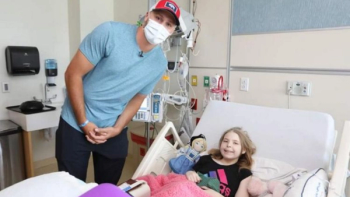
Hannah was 11 when she was diagnosed with acute lymphoblastic leukemia (ALL). Four years, two relapses and a 53-day hospital stay later, she is back in school.
Columnist Linda Cohen explores the emotional toll of aging with lymphoma, the pressure of cosmetic trends, and finding beauty in enduring love.
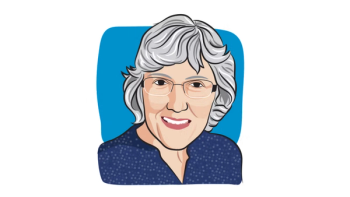
There is a topic I think is seldom discussed, among women and men alike. As I approach my 75th birthday this fall, I’ve been thinking about something I’ve always said: I want to grow old gracefully.
I am realizing now that it is harder than I thought. Growing older isn’t easy — period. With cancer, I am finding it that much harder.
First, I know my cancer has taken a toll on me. I have had radiation three different times to my right eye, and the third time included my left eye as well. Three years later, I had radiation on my cheeks. None of this has helped matters. I’ve been told that with my lymphoma, skin cancers are more prevalent. To date, I’ve already had two basal cell carcinomas (one aggressive) and one squamous cell carcinoma, all on my face and head. I once told my Mohs surgeon, “No offense, but I hope I never see you again.”
He responded, “Sorry, but I’m afraid you will. It comes with the lymphoma.”
As I’ve been processing all of this, I started talking with some of my friends, as women do. I’ve come to learn that more women than I expected have had cosmetic procedures performed — everything from plastic surgery to Botox, fillers, laser treatments and more. I only know this because I began sharing my own feelings. Little by little, the truth came out, and I was definitely surprised.
I always swore that I would never go down that road. But at this point, I don’t even have that option. I have a very compromised immune system and I am highly susceptible to infection, something that is quite dangerous for lymphoma patients. There is no way I am willing to take that risk, even for something as seemingly benign as Botox.
So why has this been weighing on me so much?
Because I look around and see other women my age who appear so much younger. And that forced me to do some real soul searching. Why was I so stuck on this?
Many years ago, I read a story about a man whose wife had passed away. After mourning her for years, his son encouraged him to start dating again. The man replied, “There is something you don’t understand. When I look at women my age now, they all look old to me. I can’t see the youth they once had. But when I looked at your mother, I still saw her as young and beautiful as the day I met her. She will always be that way in my eyes.”
That stayed with me.
I talked to my husband about these feelings, and he lovingly told me he felt the same way. He still sees me as I was “back in the day.” He understood exactly what that man meant. If you’ve never known someone when they were young, it’s hard to imagine them any different than who they are now — a 75-year-old woman.
Then I came across the poem “When You Are Old” by W. B. Yeats. One line in particular struck me — the idea that true love endures not because of a youthful face, but because of a soul that never changes. That kind of love doesn’t age.
My husband has made it clear — he’s just happy I’m still here. He doesn’t want me to have any cosmetic procedures to look younger. Honestly, I can’t ask for more than that.
Recently, we were watching “1923,” the prequel to “Yellowstone” starring Harrison Ford and Helen Mirren, who is now 80. As I watched her, I thought: “This is a woman who has truly grown old gracefully.” I saw her lines, yes—but I also saw her beauty. And the way Harrison Ford looked at her—you could feel the love.
That’s when it finally clicked.
That is what my husband has been trying to tell me all along. He looks at me and still sees the young woman I once was.
It took me a while but I knew I needed to embrace how I look today, just as I always said I would. I have gratitude for a loving husband and for being alive after nearly 17 years with cancer.
Do I love how my skin is aging? Not really. But so what?
Somewhere along the way, I slowly stopped obsessing over every new line and wrinkle and began to understand that I am more than the youthful face I once had.
I chose to write about this because I know I can’t be the only one struggling with getting older, especially while also dealing with the lasting effects of cancer treatment.
I once heard that getting older isn’t for sissies.I think we can all agree — cancer isn’t either.
And you know what? Between my health and my wrinkles, I am deeply grateful, and happy to be alive. I just had to get here.
“Aging is not a curse. It’s a privilege denied to many. Embrace it with gratitude.” Author unknown
This piece reflects the author’s personal experience and perspective. For medical advice, please consult your health care provider.
For more news on cancer updates, research and education,