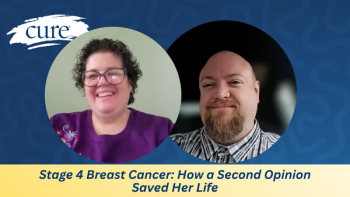
Diagnosed with stage 4 breast cancer weeks after giving birth, Eileen Carter explains why getting a second opinion changed the course of her care.
Jim Day was told he had six months to live after a stage 4 melanoma diagnosis. A cancer-fighting virus helped shrink his tumors and gave him hope.
When Jim Day was diagnosed with stage 4 melanoma, the cancer had spread throughout his body, including to his liver, lungs, bones and lymph nodes. He was told he might have about six months to live.
“I thought I was dead,” Day told CURE.
After standard immunotherapy stopped working, Day met Dr. Gino In, a melanoma oncologist at Keck Medicine of USC, who offered him the opportunity to participate in a clinical trial testing a new approach: a genetically engineered virus designed to attack cancer.
The treatment, called RP1, is based on herpes simplex virus type 1 (HSV-1), the virus commonly associated with cold sores. But RP1 has been genetically modified so that it does not cause herpes and is designed to target cancer cells.
RP1 is an oncolytic virus, meaning it is designed to infect and destroy cancer cells while also stimulating the immune system.
The treatment is injected directly into tumors. Once inside, RP1 replicates and helps destroy the cancer cells. At the same time, it can activate an immune response that may help the body recognize and attack melanoma elsewhere in the body.
That second effect is particularly important because not every tumor can be injected.
“We think that once your body learns to kill one tumor, your immune system becomes sort of educated and learns how to fight other tumors as well that are not being injected,” Dr. In explained.
Day received RP1 injections about every two weeks and watched some of his tumors change dramatically.
One large tumor on the back of his neck began breaking down after treatment.
“I could literally put my finger down in the hole because the virus had just eaten the center out of the tumor,” he recalled.
He also experienced temporary chills and flu-like symptoms after treatment, which Dr. In said were common and generally improved within a few days.
For Day, the side effects were manageable.
“For the first day, the first up to two days, you feel kind of weird,” he said. “And then after that, you feel really normal.”
The phase 1-2 IGNYTE clinical trial included 140 patients with advanced melanoma whose cancer had not responded to or had stopped responding to previous immunotherapy.
Patients received RP1 in combination with nivolumab, an immune checkpoint inhibitor.
About one-third of patients saw their tumors shrink by at least 30%, while nearly one in six had a complete response, according to the study results.
Researchers also found that untreated tumors could shrink or disappear, suggesting that the treatment may generate an immune response throughout the body.
For patients with metastatic melanoma, that could be particularly meaningful because some tumors may be too difficult or impossible to inject.
For Day, the treatment has given him more time than he ever expected.
He recently had a period when scans showed no detectable cancer, although a new tumor has since been found in his liver.
Day does not consider himself permanently cancer-free. Instead, he views melanoma as something he will continue to manage.
“If I end up with a new tumor every six months or once a year or something like that, as long as we can kill it, I'm not going to give up,” he said.
He is now back in his studio, continuing to make art.
For Dr. In, RP1 represents a potentially important new approach for patients whose melanoma has stopped responding to standard immunotherapy.
The FDA has moved RP1 forward for advanced melanoma, while a phase 3 trial is continuing to confirm the treatment's effectiveness and better understand how long responses can last.
“I believe that oncolytic viruses will open up an important new approach to fighting cancer in some patients in the near future,” Dr. In said.
For more news on cancer updates, research and education,