Depending on dose, firmonertinib shrank tumors in 43% to 68% of patients as a first treatment for EGFR PACC-mutant lung cancer in the phase 1b FURTHER trial.
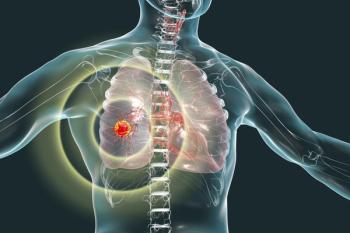
Libtayo improved survival and safety outcomes vs chemotherapy in advanced NSCLC, with 23% of patients alive at six years in the EMPOWER-Lung 1 trial.
Libtayo (cemiplimab) improved survival and response rates compared with chemotherapy in patients with advanced non-small cell lung cancer, with 23% of those alive at six years in the EMPOWER-Lung 1 trial.
Dr. Miranda Gogishvili, a medical oncologist at the High Technology Medical Center, University Clinic in Tbilisi, Georgia, said the six-year follow-up showed a median overall survival of 26 months with Libtayo versus 13 months with chemotherapy, along with improved progression-free survival and a 46% response rate compared with 21%.
She noted that patients with PD-L1 expression of 50% or more benefited across all subgroups, with the greatest benefit seen in those with PD-L1 expression of 90% or higher.
Libtayo also showed a more favorable safety profile, with fewer grade 3 or higher treatment-emergent adverse events than chemotherapy, most commonly anemia, pneumonia and fatigue.
Gogishvili: Well, with six-year follow-up, the trial demonstrated significant improvements in overall survival, progression-free survival, as well as objective response rate compared to chemotherapy. Key data points include 26 months median overall survival versus 13 months, representing a 40% reduction in the risk of death, and a 23% probability of survival at six years versus 13%.
Median progression-free survival was eight months versus five months, representing a 49% reduction in the risk of disease progression, and the objective response rate was 46% versus 21%.
So, at six-year follow-up, Libtayo monotherapy continues to demonstrate clinical benefit and prolonged overall survival and progression-free survival, as well as an acceptable safety profile compared to chemotherapy.
Well, anti–PD-1 and anti–PD-L1 inhibitors have become a critical component of systemic treatment for advanced non-small cell lung cancer without EGFR, ALK or ROS1 alterations.
At the time the EMPOWER-Lung 1 trial was initially designed, there was a need for additional treatment options that improved survival benefits and optimized chemotherapy-free treatments in patients with high PD-L1 expression, with only one agent in this class having shown superiority over chemotherapy.
Patients with PD-L1 expression of 50% or more benefit from Libtayo monotherapy. In our trial, all three subgroups — PD-L1 50% to 60%, 60% to 90% and 90% or more — demonstrated clinical benefit and better overall survival compared to chemotherapy. The greatest benefits were observed in the highest PD-L1 expression subgroup, PD-L1 greater than or equal to 90%.
It is very important for patients because Libtayo has a better safety profile, with fewer adverse events compared to chemotherapy, so it is very important for them and their caregivers as well.
In our trial, we conducted a maximum number of treatment cycles of immunotherapy, and the safety profile for the Libtayo group was much better than the chemotherapy group, with grade 3 or more treatment-emergent adverse events at 45% compared to 51%.
Mostly, these were anemia, pneumonia and fatigue.
So, Libtayo monotherapy showed significant improvement in overall survival and progression-free survival, and the safety profile was better and consistent with previously reported data.
For more news on cancer updates, research and education,