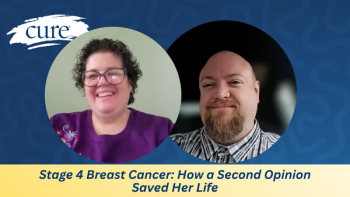
Diagnosed with stage 4 breast cancer weeks after giving birth, Eileen Carter explains why getting a second opinion changed the course of her care.

Focal cryotherapy is changing prostate cancer care. Dr. Herbert Lepor explains this milestone treatment and what it means for patients.
For decades, men diagnosed with prostate cancer faced two extremes: watch and wait, or undergo treatment that removed or destroyed the entire prostate. Neither option felt right for everyone. Now, a treatment called focal cryotherapy is offering something in between and NYU Langone recently marked a major milestone, having performed more than 1,000 of these procedures.
We sat down with Dr. Herbert Lepor, a pioneer in the field and Martin Spatz Chair, Department of Urology Chief of Urology, at NYU Langone Health to talk about how focal cryotherapy works, who it's right for, and why it's reshaping the future of prostate cancer treatment.
For years, prostate cancer treatment came down to two very different paths. If doctors didn't think the cancer looked aggressive, patients could simply monitor it through active surveillance. But roughly half of those patients would eventually need treatment anyway.
For everyone else, the choices were dramatic: a radical prostatectomy (complete removal of the prostate) or radiation to destroy the entire gland. Dr. Lepor explains that for many men, surveillance felt like too little, but removing or destroying the whole prostate, along with the side effects that come with it, felt like too much.
That gap is what led to the idea of focal therapy: treating only the area of the prostate where the cancer actually is, rather than the whole gland.
This isn't a brand-new concept in cancer care. Think of how breast cancer treatment evolved from full mastectomies to lumpectomies for many patients, or how colon cancer and kidney cancer are now often treated by addressing only the affected area rather than removing the entire organ. Prostate cancer, Dr. Lepor says, is catching up, thanks largely to better imaging.
"So about 15 years ago, the concept of focal therapy evolved... The concept of focal therapy struck me as a very exciting paradigm for treating prostate cancer, and so began our serious investigation of focal therapy for focal prostate cancer." — Dr. Herbert Lepor
Years ago, prostate biopsies were something of a guessing game. Doctors would take 12 random tissue samples because there was no reliable way to know exactly where cancer might be hiding.
The game-changer was MRI imaging, which allowed doctors to pinpoint suspicious areas before ever taking a biopsy. Research confirmed that when cancer showed up as a single site on MRI, it was genuinely focal, meaning it hadn't spread throughout the prostate. That discovery opened the door to treating only that specific area.
Removing the entire prostate can affect much more than the cancer itself. Dr. Lepor, who helped pioneer nerve-sparing surgery techniques early in his career, explains that even with the best surgical techniques, many men experience:
"While the nerve-sparing radical prostatectomy... certainly improved sexual function outcomes, we certainly didn't solve the problem” said Lepor.
Radiation carries its own set of trade-offs, often including several months of hormone therapy, along with potential urinary and sexual side effects, and a small increased long-term risk of bladder or colon cancer.
Focal cryotherapy takes a different approach. Instead of treating the entire prostate, doctors use imaging to precisely target and freeze only the cancerous tissue aiming to preserve the healthy tissue and nerves around it.
Focal cryotherapy isn't the right choice for every patient. According to Dr. Lepor, the ideal candidate is someone whose cancer is truly focal limited to one specific area of the prostate, as confirmed by MRI and targeted biopsy.
"If the significant prostate cancer is really limited to one area of the prostate, then that patient is the ideal candidate for focal therapy. If they have aggressive cancer throughout the prostate, they don't have focal disease, so focal therapy really isn't an option for those men."
One of the most talked-about aspects of focal cryotherapy is how quickly patients can bounce back. Dr. Lepor shared the story of Broadway performer André De Shields, who returned to rehearsals just two days after his procedure determined not to miss opening night.
"He came to me and said, 'You know, we're opening on Broadway in a month. I ain't doing surgery. I ain't doing radiation because that's going to lay me up. I got to be back to rehearsing like in two days.' I said, 'Andre, far as I'm concerned, you want to go rehearse... be my guest."
Dr. Lepor is quick to point out that this isn't a guarantee for every patient. He typically places no restrictions on diet or activity after the procedure, but recovery timelines vary from person to person.
"Listen, when I counsel patients I say you could advance your diet as tolerated... I put absolutely no restrictions. But that doesn't mean everyone is going to be like Andre De Shields. He's quite an individual."
Still, for many men, focal cryotherapy means avoiding the extended downtime often associated with surgery or radiation.
NYU Langone recently published seven-year follow-up data, and the results are encouraging. Among men with intermediate-favorable-risk prostate cancer the group considered ideal candidates for focal therapy:
The quality-of-life differences were just as striking. Among men who had strong sexual function before treatment:
"We're not doing so bad in terms of cancer control, but we've eliminated incontinence, we've greatly improved sexual function outcomes."
Dr. Lepor is optimistic about where the field is headed particularly around improving how doctors identify which patients are at risk for aggressive disease earlier, when it's most treatable.
"When you're curable, you don't know you got it," he explains. "And when you know you got it, it's too late." That's why he emphasizes the importance of screening, alongside continued research into better imaging and molecular tools that can help doctors and patients make more informed decisions.
Focal cryotherapy represents a meaningful shift in prostate cancer care one that gives many patients a path between "doing nothing" and "doing everything." For men with focal, intermediate-risk disease, it offers a way to treat the cancer directly while preserving quality of life.
If you've been diagnosed with prostate cancer, ask your care team whether focal therapy might be an option for you. The right treatment isn't one-size-fits-all and understanding your choices is the first step toward making the one that's right for you.
For more news on cancer updates, research and education,