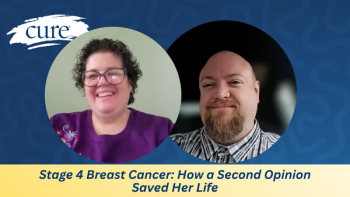
Diagnosed with stage 4 breast cancer weeks after giving birth, Eileen Carter explains why getting a second opinion changed the course of her care.
In episode 2 of the After Cancer Podcast, Dr. Leslie Waltke explores why the end of treatment can feel harder than anything that came before it.
The bell rings. Nurses cheer. Texts pour in. For many people finishing cancer treatment, the last day looks a lot like a celebration, and rightfully so. But for a significant number of survivors, something unexpected happens on the way home.
"I cried the whole way home. I felt completely abandoned. I felt more lost than ever," said Sarah, a woman in her late 50s who had just completed chemotherapy. Her experience was shared by Dr. Leslie Waltke in episode 2 of the After Cancerpodcast.
Sarah's story, Waltke said, is not unusual. It reflects what she calls the finish line myth — the widespread assumption that the end of treatment marks the end of cancer's impact.
"Cancer treatment may end on a specific day, but healing rarely does," Waltke said.
Follow Dr. Waltke on Instagram at @thecancerrecoveryroom and on Facebook at facebook.com/lesliewaltkept.
During active treatment, people with cancer are held inside a structure: scheduled appointments, lab work, imaging and a clinical team watching closely. Even when exhausting and frightening, that framework provides a kind of predictability. Then treatment ends, everyone cheers and that scaffolding disappears.
"During radiation I had a team. Afterward, I had a calendar full of blank space," one of Waltke's patients, a man being treated for prostate cancer, told her.
That blank space, she explained, is often where fear settles in — and research supports why. According to Waltke, large national survivorship studies show that within the first five years after treatment, about 15% of survivors report depression, 15% report anxiety and 10% report thoughts of death. The transition from active treatment to survivorship, she noted, has been identified as one of the most stressful points in the entire cancer experience, alongside diagnosis and treatment.
Younger survivors face particular challenges. When cancer arrives during critical life stages, it can disrupt careers, relationships, finances and fertility — pressures that compound the emotional weight of survivorship.
"I thought finishing radiation would be my victory lap. Instead, I felt lonelier than ever," said Maria, a survivor in her 30s. "Everyone was saying, 'Congratulations, you're done.' I wasn't celebrating. I was processing grief, trauma, fear and physical pain."
Survivorship's challenges aren't only emotional. Waltke described two categories of ongoing physical symptoms that frequently go unaddressed.
Long-term side effects are those that begin during treatment and persist after it ends. Up to 70% of survivors experience ongoing fatigue, Waltke noted, along with cognitive fog — officially known as cancer-related cognitive impairment — as well as pain, weakness and anxiety. These can affect work, daily relationships and self-confidence well into survivorship.
Late side effects may not surface until months or years after treatment concludes. These can include heart problems, nerve pain, bone loss, infertility and lymphedema from radiation or surgery-related scar tissue. While they affect a smaller portion of the survivor population, their delayed onset can make them particularly difficult to anticipate.
"Many people probably were told about these late effects," Waltke acknowledged, "but it was most likely grouped in with a thousand different things you were told at the end of treatment, when your poor brain was functioning at about 20%."
Waltke was candid about survivorship care's structural limitations. The healthcare system, she explained, was built to treat cancer and prevent death, not to support the decades of life that can follow. Survivorship as a field is still young, and many survivors never receive a formal survivorship care plan. Many primary care physicians also lack adequate training to manage cancer's long-term effects, and disparities in age, race, income and geography widen those gaps further.
Still, she said, progress is being made. Survivorship care plans are now a recommended standard of practice, dedicated survivorship clinics are growing in number and research on late effects, emotional health and return to work continues to expand.
For survivors navigating this transition, Waltke offered several starting points. Asking a provider for a survivorship care plan — if one was never provided — can be a meaningful first step. Journaling can help make sense of shifting emotions and physical symptoms. Physical therapy, even months or years after treatment ends, can rebuild strength, manage pain and restore function. Counseling helps process trauma and reduce anxiety. Support groups, whether in person or virtual, offer community among people who understand the experience firsthand. And reconnecting with a primary or family physician can help coordinate care long after oncology visits end.
"When I realized I could ask for a survivorship plan, everything shifted," said James, a colon cancer survivor. "I finally felt like there was a map, even if I had to draw it myself."
Waltke closed the episode with reflection prompts for listeners: Did you feel the finish line myth, and if so, when did it hit you? Where do you feel most supported, and where do you notice the biggest gaps? What is one question you wish your provider would ask you now?
"Survivorship is not about moving on," she said. "It's about moving forward with awareness, with tools, with support and with belonging."
The After Cancer Podcast is hosted by Dr. Leslie Waltke, an oncology physical therapist with more than three decades of experience working with people living with and beyond cancer. New episodes are available on her YouTube channel.
For more news on cancer updates, research and education,