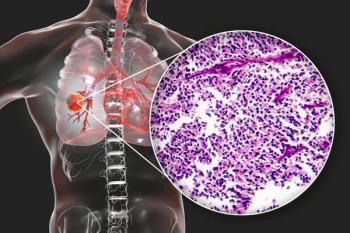
For Lung Cancer Awareness Month, answers to common patient questions about biomarker testing in non-small cell lung cancer: which gene changes doctors look for, blood vs. tissue tests, insurance and retesting.
Patients with PD-L1-negative non-small cell lung cancer experienced longer progression-free survival with sac-TMT plus Keytruda compared with chemotherapy plus Keytruda in a phase 3 trial.
Patients with advanced non-small cell lung cancer (NSCLC) who received sacituzumab tirumotecan (sac-TMT) plus Keytruda (pembrolizumab) had longer progression-free survival than those receiving chemotherapy plus Keytruda, according to findings from the phase 3 OptiTROP-Lung06 trial.
The study, published in The New England Journal of Medicine, found that median progression-free survival was 15 months with sac-TMT plus Keytruda compared with 5.7 months with chemotherapy plus Keytruda. Progression-free survival refers to the length of time patients live without their cancer worsening or death from any cause.
The combination reduced the relative risk of disease progression or death by 51%. However, overall survival data were not yet mature, meaning researchers have not determined whether the combination helps patients live longer overall.
The trial included 455 patients with previously untreated, locally advanced or metastatic nonsquamous NSCLC. All patients had PD-L1-negative tumors, meaning fewer than 1% of their tumor cells expressed PD-L1, and lacked targetable genomic alterations.
PD-L1 is a protein that can help cancer cells avoid detection by the immune system. Patients with PD-L1-negative tumors may be less likely to benefit from immunotherapy alone.
Chemotherapy plus Keytruda is a commonly used first-line treatment for these patients. Researchers evaluated whether replacing chemotherapy with sac-TMT, an antibody-drug conjugate designed to deliver cancer-fighting medication to cells expressing the protein TROP2, could improve outcomes.
Of the patients enrolled, 229 received sac-TMT plus Keytruda and 226 received chemotherapy plus Keytruda.
After a median follow-up of 9.7 months, patients receiving sac-TMT plus Keytruda experienced significantly longer progression-free survival compared with those receiving chemotherapy plus Keytruda.
Researchers also evaluated the percentage of patients whose tumors shrank or disappeared following treatment and how long those responses lasted.
Tumor responses occurred in 50.2% of patients receiving sac-TMT plus Keytruda compared with 47.3% receiving chemotherapy plus Keytruda.
Among patients whose tumors responded to treatment, the median duration of response was 13.6 months with sac-TMT plus Keytruda compared with 6.8 months with chemotherapy plus Keytruda.
Duration of response refers to the length of time a tumor continues responding to treatment before the cancer progresses.
Grade 3 or higher treatment-emergent adverse events occurred in 47.6% of patients receiving sac-TMT plus Keytruda compared with 60.6% receiving chemotherapy plus Keytruda.
Anemia, or a low red blood cell count, was the most commonly reported adverse event in both groups, occurring in 82.5% and 84.5% of patients, respectively.
However, stomatitis, which can cause inflammation and sores in the mouth, occurred more frequently among patients receiving sac-TMT plus Keytruda (51.1%) compared with chemotherapy plus Keytruda (8.4%). Most cases were mild or moderate.
Fatal treatment-emergent adverse events occurred in 2.2% of patients receiving sac-TMT plus Keytruda compared with 6.2% receiving chemotherapy plus Keytruda. These events occurred after treatment began but were not necessarily caused by the treatments.
The findings suggest that sac-TMT plus Keytruda may delay disease progression in patients with advanced PD-L1-negative nonsquamous NSCLC without targetable genomic alterations.
However, longer follow-up is needed to determine whether the combination improves overall survival. The study was conducted in China, and sac-TMT remains investigational for this treatment setting in the United States.
The results provide additional evidence supporting research into antibody-drug conjugates combined with immunotherapy as a potential alternative to chemotherapy-based treatment for certain patients with advanced NSCLC.
For more news on cancer updates, research and education,