After 17 and a half years with metastatic primary peritoneal cancer, a former hospital executive explains how an AI health agent helped her after discharge.
Breast cancer survivor Sue Weldon discusses survivorship gaps, integrative therapies alongside treatment and why caregivers should prioritize themselves.
When Sue Weldon finished her last round of chemotherapy for breast cancer 22 years ago, she was told she was done. She felt far from it.
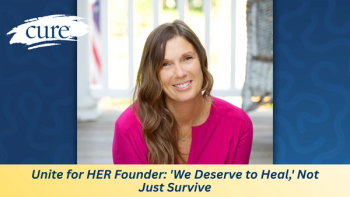
Weldon, CEO and founder of the national nonprofit Unite for HER and author of the new book "Heal, Empower, Restore," spoke with CURE about the gaps in survivorship care, how integrative therapies work alongside standard treatment, the side effects participants struggle with most and why caregivers need to prioritize themselves, too.
This interview has been edited for length and clarity.
Weldon: We deserve more than just to survive, right? We deserve to heal, and that happens emotionally and physically. It was a big day. I had 12 rounds of chemotherapy, and when you look back, you realize that was just the beginning of your healing journey. You actually had to get that body that worked so hard to get you through chemotherapy back and restored. I needed resources. I needed therapies, and that's why I created Unite for HER.
During chemotherapy, I could barely get myself moving. The cancer-related fatigue was tough. I was forced into medical menopause. I had bone pain, neuropathy, headaches. But I learned the power of acupuncture, yoga and nutrition. When I could bring these into my standard of care during treatment, and even after treatment, that's where the healing began. That's where I got confidence again, control again in a disease I had no control over.
Wellness is an action. It takes a lot of time, dedication and resources. That's why I created Unite for HER, so everybody could have those resources that I was fortunate enough to have. I'm 22 years out, and I'm still learning what's good for my body as I age. Wellness isn't a fad; it's an action that people have to invest in.
It's not an either-or. It is in addition to our medical teams. We work side by side with them — our physicians, surgeons, oncologists and radiologists. They are so grateful to see us come in and support them during cancer treatment.
Treatment can be arduous. The medical community knows the havoc that is wreaked on the body from chemotherapy and radiation. When we come in, they know they have resources that can help people manage side effects better, stay on treatment, control their symptoms, help with their emotional well-being and distress level, and even help with financial burden, because we fund and deliver it all.
You'll hear integrative, supportive and complementary used interchangeably. It's combining the medical community with these services so people can make a plan to adhere to treatment, do better with their side effects, have better emotional clarity and lessen their stress levels. There's so much research presented at symposiums like the San Antonio Breast Cancer Symposium, ASCO and the Society for Integrative Oncology. We deliver what the research shows by funding and delivering it for individuals — now 11,000 of them across the nation.
Just bring it up. If you go to uniteforher.org, you'll see the key findings, the science and the research. We have a whole page at uniteforher.org/sabcs because we've done four posters now. The medical community is getting more and more aware of it — very different than 22 years ago.
You can share, "I know an organization, Unite for HER. They fund and deliver this. I would like to add this in addition to my standard of care. Would you be open to talking to some of the providers?" Some of our physicians are dual-trained, and oncologists are very familiar with the outcomes of people moving and doing yoga during treatment.
Go in with the science, but also go in with uniteforher.org. They can pull it up online right when they're talking to you. A patient that has control and can self-advocate is a good patient for them.
"Heal, Empower, Restore" is a roadmap to help the body and mind during cancer care. It's the Unite for HER experience in print, and it just came out in September. Everyone's a little different, but the most difficult symptom we hear about most often is fatigue. It's debilitating. It's not fatigue that you and I may feel at 4 o'clock because we had a long day and can grab a cup of coffee. It's fatigue where they can't get out of bed or get to work. That is where we lean in and give them access to tools like movement, meditation, acupuncture or massage therapy.
Nutrition is key to getting those energy stores up. We have four registered dietitians on staff, and they're available to you for life to answer any of your questions. Digestive issues are also big — mouth sores, metallic taste and constipation or diarrhea from medications that can be so severe you can't get out of bed. We help with a nutritional plan based on whole foods, with a lens of not what you can't eat, but what you can add to help you get through these really tough side effects.
Unite for HER funds and delivers integrative services for everyone who comes to our door. We feel that if you are diagnosed with cancer, you are in need. We lean into our undersupported and underserved communities, so much so that 56% of our population is underserved or undersupported. We partner with hospitals in areas that we know are in need of these services.
That is the gap — insurance doesn't cover it. So you can come our way. Go to uniteforher.org/apply, and we will fully fund you for one of two programs: the Passport or the Empowered Living program. We do a lot virtually, like a telehealth approach, which allows us to treat everyone across the nation. Know that it's for breast and ovarian cancer. I wish we could do it for everyone because it is good for everyone.
You can also buy the book on Amazon. At the end of each chapter, we have a section called "Moving Forward," so once you learn about something like the power of nutrition, you know how to implement it.
Please prioritize yourself. I know it firsthand. I was a caregiver one year prior to my diagnosis, and I ran myself ragged trying to be all and do all for everyone. The body keeps the score, and it catches up with you. You have to keep your cup full in order to give to somebody else. I look at how it was on my husband and my children. My children were so little at the time, and you don't realize the emotional impact it's having until years later.
Prioritizing yourself is not selfish, and it shouldn't be a luxury. At Unite for HER, we invite caregivers into the sessions. They can come to the wellness orientation, and our hope is that they're listening to what we're telling them to do for their loved one but also implementing it in their own routine. They can be a part of the yoga, and they can do partner counseling. It's important to have a community around you that lifts you up. Caregivers need a community that lifts them up, too.
For more news on cancer updates, research and education,