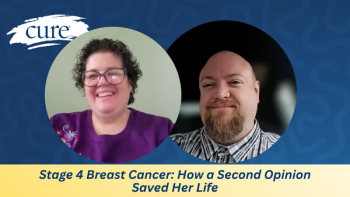
Diagnosed with stage 4 breast cancer weeks after giving birth, Eileen Carter explains why getting a second opinion changed the course of her care.
Physician Dr. Sheri Prentiss advocates for baseline measurements and proactive surveillance to detect and treat breast cancer-related lymphedema early.
For many, surviving breast cancer is the finish line. But for Dr. Sheri Prentiss, a physician and survivor, the end of her treatment marked the beginning of a life-altering complication: breast cancer-related lymphedema (BCRL).
The condition eventually forced her to retire from her medical practice, but it sparked a new mission. Today, as a public health advocate, Prentiss is part of a national conversation on shifting the standard of care from reactive treatment to proactive prevention.
In a recent interview with CURE, Prentiss emphasized that the current "wait and see" approach to lymphedema is failing patients. The key to changing outcomes, she argued, lies in prospective surveillance — measuring patients before treatment begins to establish a personal baseline.
"No baseline means no early detection," Prentiss stated. "No early detection means a missed opportunity."
She pointed to data from the PREVENT trial, which highlights the inadequacy of traditional methods. Without a baseline, up to 71% of cases using bioimpedance spectroscopy (BIS) and 88% of cases using tape measurements may go unidentified in their earliest, most treatable stages. Prentiss noted that baseline measurement is no longer just a "best practice" — it is now aligned with updated NCCN guidelines, reinforcing it as the minimum standard of care for any cancer patient.
Beyond clinical measurements, Prentiss advocated for a shift in patient education. She believes that compression garments and self-management strategies should be introduced early in the journey. When patients understand their risks, they are more likely to engage in their own care.
A critical component of this engagement is self-awareness. Prentiss said she often tells survivors: "Patients are going to feel it before we see it." She encourages survivors to speak up the moment something feels "off," even if visible swelling hasn't occurred yet.
The vision Prentiss shared for the future of oncology is one of multidisciplinary collaboration. Survivorship care should not exist in a vacuum; instead, oncology, rehabilitation and patient navigation must work in tandem to ensure no patient falls through the cracks.
Furthermore, she highlighted the urgent need for health equity. Access to education, specialized garments, and physical therapy remains a significant barrier for many. "If you don't make things accessible, patients can't get the care that they need," she said.
For more news on cancer updates, research and education,