Lunsumio added to Revlimid kept relapsed or refractory follicular lymphoma from worsening longer than Rituxan plus Revlimid in the phase 3 CELESTIMO trial.
Living long-term with cancer means learning to live in chapters. There are calm chapters and uncertain ones. Seasons of stability and seasons of intervention.
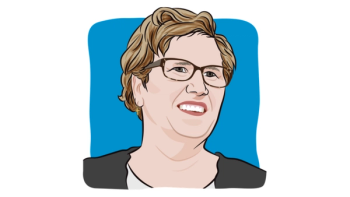
When I first heard my diagnosis, I was told my cancer had no cure, but I shouldn’t worry because I could live with it for a long time. Easy for them to say. My small lymphocytic lymphoma surfaced 16 years ago and has morphed over the years. Back then, I could not imagine what “a long time” would feel like. Now, after years of living with cancer by my side — always there — I can offer a different perspective.
When I first heard the words, “There is no cure, but…” all I registered was that first part. I felt instantly nauseous. My life flashed before me. At 57 years old, my mortality delivered a sharp wake-up call. I looked at my husband for comfort, but he looked as if he had just been punched in the stomach. We drove home in silence. We were both in shock. There was nothing to say.
We were advised to meet with oncologists and perhaps consult more than one before deciding who would accompany me on this journey. I began researching specialists and seeking opinions. And so the process began.
When I got home, of course, I Googled everything so I would have some information going into those appointments. At that time, I found very little that calmed me. Statistics felt cold. I hoped the doctors would offer something steadier.
I was introduced to the “watch and wait” approach — testing every three months and closely monitoring bloodwork and symptoms. Some patients struggle with that uncertainty. I was told we didn’t want to “use up options” too soon. Surprisingly, I knew I could handle it.
What surprised me most during those early years was how much medicine was changing in real time. At appointments, I began hearing phrases like “targeted therapy” and “immunotherapy,” words that were not commonly used when I was first diagnosed. I realized that while I was adjusting to living with cancer, researchers were working tirelessly behind the scenes to outsmart it. I wasn’t standing still in a fixed prognosis. The landscape was evolving — and so was I.
Over time, my understanding deepened. My doctors spoke of clinical trials, precision medicine, and therapies tailored to specific mutations. Instead of asking, “How long do I have?” I began asking, “What is becoming possible?”
I have received antibody therapy that specifically targets my B-cell lymphoma. I underwent radiation to my eyes and cheeks. I took Calquence (acalabrutinib), a BTK inhibitor designed to block signals that help cancer cells survive. My doctor described watching my enlarged lymph nodes “melt away.” That word — melt — felt miraculous.
Today, researchers are studying combination therapies that may become my next step if needed. Treatments that did not exist when I was diagnosed are now standard care. What once required five long hours at an infusion center can now, in some cases, be done in the comfort of my home in about two hours. These advances were not available 16 years ago. They continue to give me hope for my future.
Living long-term with cancer means learning to live in chapters. There are calm chapters and uncertain ones. Seasons of stability and seasons of intervention. What medical advances have given me is the confidence that another chapter is likely waiting if I need it. Instead of feeling cornered, I feel supported by science that continues to move forward. Even when options narrow, new ones often emerge.
What medical advances mean to a long-term patient is this: time.
Time to watch grandchildren grow.
Time to celebrate anniversaries.
Time to write, to pray, to hope.
Science has given me options. It has given me space between crises. It has transformed a once terrifying diagnosis into something I live with rather than constantly run from.
Sixteen years ago, I could not see this far ahead. I only saw the words “no cure.” Today, I see innovation. I see researchers working tirelessly. I see physicians staying current with evolving treatments. I see a future that continues to expand, even for someone living with a chronic cancer.
Medical advances are not abstract breakthroughs to me. They are deeply personal. They are the reason I am still here — not just surviving, but living with gratitude and guarded optimism.
And that, for a long-term patient, means everything.
This piece reflects the author’s personal experience and perspective. For medical advice, please consult your health care provider.
For more news on cancer updates, research and education,