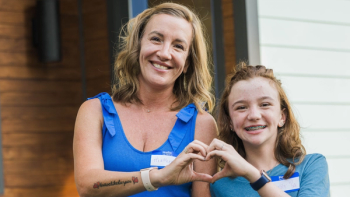
Diagnosed with leukemia at 8 years old, Harper feared that losing her hair would change who she was. She reflects on body image, confidence and finding a sense of herself during cancer treatment.
Pediatric Cancer Research Foundation CEO Danielle Fragalla discusses the biological differences in pediatric cancer and the need for treatments designed for developing bodies.
Treating pediatric cancer is not as simple as scaling down adult protocols for a smaller patient. While high survival rates are often celebrated, the biological reality of childhood malignancy requires a specialized approach that accounts for the unique vulnerabilities of a developing body. Many survivors today face a lifelong journey of late effects — ranging from cognitive delays to cardiac complications — resulting from toxic therapies originally designed for adults.
In an interview with CURE, Danielle Fragalla, CEO of the Pediatric Cancer Research Foundation (PCRF), discussed the need to shift the research goalpost from survival to toxicity-free survival. Fragalla highlighted why pediatric cancers are fundamentally different from adult diseases and how current funding gaps impact the development of child-specific treatments. By prioritizing research into therapies designed for growing bodies, PCRF aims to ensure that children who beat cancer can go on to live healthy, full lives well into adulthood.
Fragalla: A pediatric cancer is fundamentally different from adult cancer. Either biology is different, or the disease patterns are different. The way that a child's body responds to treatment is different. Children are still growing and developing, so treatment decisions carry lifelong implications for a child that is going through treatment.
Pediatric cancer has also just been approached through a framework that is shaped largely by adult oncology, and that always tends to be an eye opener for people when we share that with them; the treatments, most of the time, are not specialized for these smaller, developing bodies. Children deserve the research, the therapies, the care models that are designed specifically for them, rather than these long-term harsh treatments that impact them and have side effects for them throughout the rest of their life.
Treatment-related toxicities can affect every aspect of a child's life, impacting them physically, cognitively, and emotionally. They can have [these toxicities] after the treatments unfold, and it can either happen soon or also later in life. When a child finishes treatment, they may struggle with learning differences, developmental delays, cardiac complications, infertility, secondary health conditions, mental health conditions and so much more and it can also influence them in school, their relationships, employment, mental health, well into adulthood, which is not something that a lot of people understand.
It's very different than when an adult is diagnosed and is treated. Most often, which is wonderful, they can go on and live a pretty normal life after that; the toxicities from the treatment [in pediatric patients] are so fundamentally different and impact their little developing bodies in such a way that most of the time it's a lifelong journey for them after that.
That is something that we talk about a lot — survival is just no longer the only measure of success. And of course, we want more children to survive cancer and that is the ultimate goal, that they survive cancer. But, what we see as just as important is having the conversation that these survivors face the long-term late effects that follow them for decades. When you're looking at the statistics and the data, it can be a little misleading, because I hear more often, “Oh, it's wonderful,” we're hearing up to 90% survival rates are happening in pediatric oncology. Well, yes, this is true, but that is also only for specific types of cancer. ALL is doing extremely well in this area, but it only tracks them for five years. And so, you're not seeing after five years what happens from these treatments, and a lot of time, most of the time, they can still be impacted by the treatment and still have some of these after-effects that we've talked about. And it doesn't include secondary cancers. It doesn't include the mental health component of it. It doesn't include the educational support and the physical health and the heart disease and all of these things that we're seeing from the treatments, and also doesn't include some of the other cancers.
People see that and think, “Oh, that's a 90% survival rate across all cancers,” which is misleading. It's not across all cancers. Brain tumors are still the number one cause of disease-related deaths for children with pediatric cancer. And pediatric cancer is still the number one cause of death for children, and so when you think about the data and the statistics, it can be a little bit misleading; those numbers are for the United States. Globally, survival rates are much lower. It also doesn't include different ethnicities, socioeconomics and access to care. As a result, the data is not truly reflective of what we're seeing across age, race, and socioeconomic groups.
Some of the economic barriers, number one, it is the lack of funding for research. We are not seeing enough funding going into pediatric cancer research, which also includes survivorship. There is less than 4% of funding that goes into pediatric cancer, and that has actually decreased in this last couple of years due to some of the freezes on direct expense funding from the NIH funding some of these institutions have received. That has put even a harder barrier within us being able to progress more research and better outcomes for these families.
There isn't as much of an incentive to go into the field. Researchers are coming up against some pretty significant roadblocks. There's not a lot of funding that goes into this area, so to steer them into the field, there's just not a lot of incentive to go into it, as well as they're getting paid far less than other oncology fields. We need to make sure that we still have our researchers and physicians going into the field to care for the families in need. The way that cancer impacts a family, it impacts the entire family. When a child is undergoing pediatric cancer treatment, a parent needs to be with them. And if you are relying on two working parents to financially support your family, that means that one parent has to no longer work and support their child. So there is a huge financial burden for the family and enabling them to receive that care that they need, let alone if they are not geographically in a location that it has access to care, they have to travel hundreds of miles to receive the care that they need. It becomes very much a burden on the family to have the finances to be able to support themselves and their family through the treatment.
We're leaning into equitable access to care as well as survivorship and mental health initiative programs, and so we're partnering and funding with some of the institutions around some of their travel programs to ensure that families have the access that they need and the financial support that they need to receive the care that they need.
Transcript has been edited for clarity and conciseness.
For more news on cancer updates, research and education,