

Take-home messages from a discussion on the use of biomarker testing, and newer, novel-based strategies to treat patients with non-small cell lung cancer.
Take-home messages from a discussion on the use of biomarker testing, and newer, novel-based strategies to treat patients with non-small cell lung cancer.
Preferences for rechallenging patients with non-small cell lung cancer with immunotherapy based on previous experiences in terms of treatment-related side effects.
Julie Fisher, MD, explains how she assesses HER2-positive breast cancer patients for treatment response, what side-effects can occur and how they can be managed.
Strategies that can help various health care professionals best mitigate or manage side effects associated with newer treatments in non-small cell lung cancer, such as immunotherapy.
Jocelyn Mueller describes the preoperative treatments she has received for HER2-positive breast cancer, and the questions she had for her medical care team.

Sheila McGlown identifies the racial disparities that exist in the treatment of breast cancer, particularly those faced by women of color, and discusses reasons why these disparities may exist.
The panel discusses strategies for locating appropriate support groups for patients with metastatic breast cancer.
CURE spoke with Stacy Lloyd, board member of the VHL Alliance, about the treatment options for patients with VHL.
CURE spoke with Stacy Lloyd, board member of the VHL Alliance, to better understand VHL and its impact on cancer.

After missing his flight, voice actor Rob Paulsen recorded a vlog in the airport where he discusses the “platinum lining” behind his cancer diagnosis when it comes to everyday hassles like travel.
As a part of its “Speaking Out” video series, CURE spoke with Stacy Lloyd on behalf of the VHL Alliance, about discussing hereditary cancer with family members and how a diagnosis can lead to earlier surveillance for the disease.
CURE spoke with Stacy Lloyd, board member of the VHL Alliance, about disparities seen in VHL and its patient population.
CURE spoke with Stacy Lloyd, board member of the VHL Alliance, about VHL as a rare disease and resources available for patients to learn more.
The significance of shared decision-making between patients and lung oncologists when considering a novel-based therapy as treatment for non-small cell lung cancer.
Dr. Julie Fisher details the therapies used for HER2-positive breast cancer in the post-operative setting, including newly available treatment options, and reviews data supporting the choice of therapy for each patient.
Considerations for treating patients with non-small cell lung cancer with single-agent immunotherapy vs chemoimmunotherapy.
Dr. Julie Fisher, an expert oncologist, describes the range of treatment options for HER2-positive breast cancer in the pre-operative setting.
View the full CURE® Educated Patient® Webinar: Understanding Myeloproliferative Neoplasms (MPNs) and Treatment Options on demand.

Watch the entire Lung Cancer Heroes® presentation here!
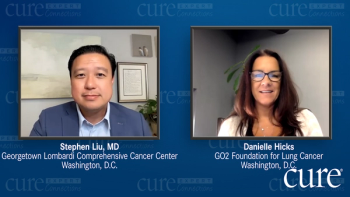
Stephen Liu, MD, and Danielle Hicks clarify the importance of involving patients and caregivers in discussions about non-small cell lung cancer molecular testing.
Thought leaders give an overview on KRAS-mutated non-small cell lung cancer and the treatment options available.
Lisa Laudico provides insight into the value of support groups in metastatic breast cancer.
Julie Larson, LCSW, discusses the concept of self-inventory and questions patients may ask themselves to evaluate their health.

Debbie's Dream Foundation wants every state to recognize November as Curing Stomach Cancer Month, so we've made it easy for you to help make this happen.

View the full CURE Educated Patient Kidney Cancer Summit on demand.
Preferences for repeat biopsies upon progression in non-small cell lung cancer following frontline therapy with a targeted treatment approach.
Jocelyn Mueller, a patient with HER2-positive breast cancer, explains how she received her diagnosis.
The pros and cons of conducting PD-L1 testing in patients with non-small cell lung cancer.
Julie Fisher, MD, gives a brief overview of HER2-positive breast cancer and the tests available for diagnosis.
Stephen Liu, MD, and Danielle Hicks illustrate how molecular testing impacts targeted therapy selection in non-small cell lung cancer.