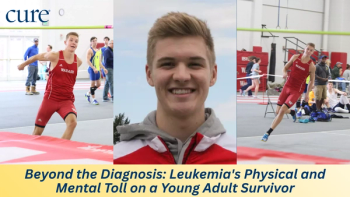
Six years after being diagnosed with B-cell ALL at 21, William Yank opens up about the physical changes of treatment, the emotional weight of constant care and the role hope plays in his survivorship.
Nicole Schultz was treated for acute myeloid leukemia as a teenager. Two decades later, chronic graft-versus-host disease and ongoing survivorship monitoring remain part of her care.
No one she knew had survived cancer, and there she was, diagnosed with acute myeloid leukemia (AML) at 14.
"I immediately just felt like my life was over," Nicole Schultz said in an interview with CURE.
However, rather than treating her like a teenager who was dying, the nurses at City of Hope encouraged her, joked with her and talked to her as though she would get through what was ahead.
"They believed in me more than I can believe in myself, and that made me want to fight harder," she said.
Her treatment included full-body radiation and two bone marrow transplants in 2005 and in 2009. She spent 11 months in the hospital during the first one, later developed chronic graft-versus-host disease (GVHD), enrolled in clinical trials of treatments for it and continues to be followed through the City of Hope Survivorship Program. More than 20 years later, she is still learning to live the life that came after cancer.
Schultz's first transplant kept her hospitalized for close to a year. Family and friends visited less often as the months went on, but her parents and siblings stayed close, and her care team became a second source of support.
"My life had stopped, but the rest of the world outside is continuing to go," she said. "That was the hard part."
Child life specialists encouraged her to leave her room, spend time with other pediatric patients and take part in activities when she felt well enough. When she did not want to get out of bed, the staff pushed her to open the blinds. When she was awake overnight and had lost track of whether it was day or night, nurses invited her to sit with them.
"I never had to be alone, alone," Schultz recalled. "I always had somebody there for me in my corner."
Her second transplant brought a different set of fears, along with evidence of how quickly treatment had changed in the four years between the two procedures.
"It gave me a lot of hope because before my second transplant, all I ever heard about AML was if you get it a second time, like you're dead," she said. "Nobody survives it a second time."
About a year after her second transplant, Schultz began having symptoms her doctors initially struggled to explain. Her joints and connective tissue tightened and calcified, her calves and ankles swelled and her range of motion narrowed until she could no longer bend over to put on socks or dress herself.
Doctors eventually identified chronic GVHD, a complication of transplant in which donor immune cells attack the recipient's tissues. At the time, Schultz noted, chronic GVHD was not as well understood as it is now. She enrolled in trials of treatments for it at City of Hope, where her doctors told her they did not know whether the experimental treatments would improve her symptoms but could try to keep them from worsening.
"I was like, actually, no, not accepting that for an answer," she said.
Alongside her medical care, she started acupuncture, physical therapy, yoga and stretching, changed her diet and became more selective about the medications she took. Her mobility returned over time. She remains physically active today, although her arms still do not straighten completely.
The experience reset her expectations of what recovery would look like.
"I think that was when it opened my eyes that my immune system now is so different that forever it's going to be like a day by day thing," she said.
Through the City of Hope Survivorship Program, Schultz is monitored for long-term effects of the treatment she received as a teenager. Depending on the year, her follow-up can include pulmonary function tests, chest CT scans, thyroid ultrasounds, EKGs, echocardiograms, bone density scans and colonoscopies.
"For me, it's like I can relax because I don't have to have PTSD every five minutes," she said. "I think all survivors really should have something like this."
She had a team that knows her full treatment history, which allowed for her doctors to know what to watch for and can coordinate with one another. For instance, she developed a secondary squamous cell carcinoma on her face that was surgically removed before it reached her lymph nodes.
Schultz now records messages for City of Hope's HopeLine, which patients in treatment can call for encouragement. At 14, she had no one in her life who could tell her that surviving was possible, and she wants to be that voice for someone else.
"Believe in yourself and make that choice every day to fight. It's worth it."
For more news on cancer updates, research and education,