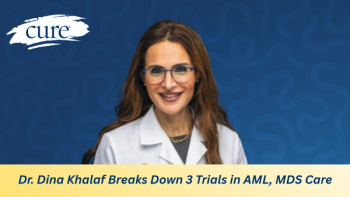
Dr. Dina Khalaf explains the ASCERTAIN-V, MyeloMATCH MM1MDS-A01 and HOVON 181 trials and what patients with AML or MDS should ask before enrolling.
Dr. Thomas Flaig discusses new therapies, biomarkers and evolving care strategies in an interview with CURE.
At the 2026 NCCN Annual Meeting, CURE sat down with Dr. Thomas Flaig to discuss the rapidly evolving landscape of bladder cancer care. During the interview, he reflected on the dramatic progress made over the past decade, emphasizing a wave of newly approved therapies that have reshaped treatment across disease stages and offered renewed optimism for patients.
In addition to therapeutic advances, he highlighted the growing role of biomarkers in guiding treatment decisions, as well as the importance of multidisciplinary care and clinical trial participation. Flaig currently serves as a professor of Medicine–Medical Oncology and as vice chancellor for Research at the University of Colorado Anschutz School of Medicine.
Flaig: It has been a remarkable 10 years for bladder cancer. If you think back to 10 or 15 years ago, we had no new treatments; we had not had new treatments for years. Clinical trials were started but not finished. Fast forward to today: over the last decade, we have had a multitude of new therapies approved.
We have had multiple approvals in a given year, and this has affected advanced metastatic disease, muscle-invasive bladder cancer and early-stage disease. We have seen across the board the ability to ask questions, design trials, complete them and have new therapies available for patients.
So, it is really a remarkable and, I think, a somewhat optimistic time in bladder cancer.
A lot of cancers were, well before bladder cancer, effectively using biomarkers, be that genetic, protein expression or a variety of different ways of assessing patients, but we had not used biomarkers in bladder cancer really at all. Fast forward to today: We have a couple.
One is FGFR3, fibroblast growth factor receptor 3, which has a specific drug associated with it, and much more recently, the evaluation of HER2 by protein expression. So IHC has been a new biomarker. So, we have FGFR3 and HER2. In both cases, when you are positive for that marker, it can open up new drug possibilities.
Over the last 10 years, we've had a lot of development, and the fields move quickly. So, I would recommend to patients that they look for a multidisciplinary team — medical oncologist, surgeon, radiation oncologist — because a lot of these therapies are going to rely on that team working together to find the best therapy for a patient. That's particularly true for patients with muscle-invasive disease, where they have a localized cancer, but it's a serious cancer. So, I would also encourage patients to look for clinical trials.
If you look at all the great things, these new options that we have had in bladder cancer over the last few years, all of them have come through clinical trials. In many cases, certainly in my practice, I've had patients for whom we'll have a clinical trial available and they'll get early access to that potential option as they're thinking through things.
I would strongly encourage patients to pursue clinical trial opportunities when it fits for them.
When we have advances in cancer, what we typically do is we use pretty aggressive therapy and ask: Can we make it better? Can we see better outcomes? And I think in bladder cancer, across the board, we've seen that we have regimens for non-muscle invasive, muscle invasive and advanced urothelial carcinoma that are better. So one of the questions a lot of us have now is: OK, we've improved cure rates and we've improved outcomes, but what is the cost in terms of toxicity? And how do we know how much therapy is enough for a given patient?
So, one of the really important unmet needs that I see is the idea of customizing the duration of therapy for an individual patient. Whenever they have had a reasonable response, we could stop therapy, because right now we just treat people for a certain length of time or a certain number of cycles regardless. That unmet need may be addressed through markers.
So, circulating tumor DNA (ctDNA), if we see cancerous DNA in your blood, that probably means the therapy is not done working or is not yet effective. If we see that clear, that might mean that some patients could stop therapy earlier and, in those cases, have fewer side effects. So, I think that's an unmet need right now in terms of customizing therapy duration.
I spoke about muscle-invasive bladder cancer. This is where patients have localized bladder cancer, but it has gotten into the muscular layer of the bladder. Traditionally, this is a time in which we pursue significant local therapy, such as surgical removal of the bladder or radiation therapy. What has really changed in that setting for muscle-invasive bladder cancer is the use of new chemotherapy agents, and we are calling these perioperative or sandwich therapies, where you give some therapy before surgery, you do the bladder removal, and you give some therapy after surgery, so it is sort of sandwiched in there.
These are therapies which include traditional chemotherapy with an immune checkpoint inhibitor (immunotherapy given before and after) or an antibody-drug conjugate plus an immune checkpoint inhibitor, immunotherapy before and after. In both cases, we have compared those now to standard therapy. We have had these, and they have improved the time until there is progression and the overall survival of patients.
So, it is an important new advancement in trying to increase the cure rate for patients with locally advanced but serious cancer.
Transcript has been edited for clarity and conciseness.
For more news on cancer updates, research and education,