An expert at ESMO 2026 explains how liquid biopsy and ESR1 testing can help guide treatment for people with HR-positive metastatic breast cancer.
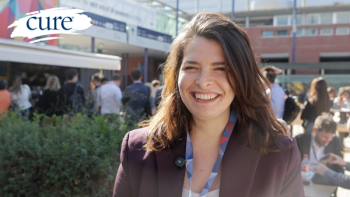
CURE spoke with Dr. Natalie S. Berger for the latest episode of the "Cancer Horizons" podcast.
CURE sat down with Dr. Natalie S. Berger for the latest episode of the “Cancer Horizons” podcast to discuss frontline treatment options for patients with metastatic triple-negative breast cancer. Berger, who recently spoke at CURE’s Educated Patient® Metastatic Breast Cancer Summit, is an assistant professor of medicine at Columbia University Irving Medical Center Division of Hematology and Medical Oncology and the associate director of breast medical oncology at New York Presbyterian-Hudson Valley Hospital in New York.
Key points discussed by Berger in the podcast included the importance of personalized medicine, with treatments tailored to tumor and patient characteristics. Immunotherapy, particularly Keytruda (pembrolizumab), is often used, especially for PDL-1 positive patients. PARP inhibitors are recommended for BRCA mutation-positive patients. Antibody-drug conjugates, like Trodelvy (sacituzumab govitecan), are emerging as effective treatments, shown to be superior to chemotherapy in combination with immunotherapy.
Additionally, patients are encouraged to be active in their treatment decisions, engage in exercise and proper nutrition, and consider enrolling in clinical trials, while caregivers are advised to support patients by understanding their needs and providing appropriate assistance.
“It's so important to make sure that your support system knows what you're feeling, knows what you're going through, and knows what your needs are,” Berger said. “Because everybody wants to help, and everybody wants to do everything they possibly can to help you get through that. And sometimes that's great, and it really provides you the support you need. But sometimes it can also be too much, or sometimes you may want something that's different than the goals that they may have, even though that goal is what they think is best for you. And so, it's so important to lean on those people, to ask them for help when you need it, and also telling people sometimes, ‘I'm OK, and I really don't need anything,’ or maybe even just giving people direction and saying, ‘Here's what I need.’”
Furthermore, Berger shared her advice for patients who are newly diagnosed with metastatic triple-negative breast cancer.
“Speak to your doctor, ask questions,” Berger said. “Sometimes it's hard to be prepared because you don't know what to ask. But, just say, ‘Why do you think this is the best treatment for me? Are there any other options out there?’ Those are kind of generic questions that may help open a conversation.
“And also, make sure to ask about clinical trials. All of our treatments that we have today came through clinical trials, and by asking for a clinical trial, by potentially enrolling on a clinical trial, I tell people this is giving you the opportunity to have access to a medication that could be the next thing that revolutionizes how we treat the disease, and getting it sooner.”
Berger emphasized that for patients, enrolling in a clinical trial is not “being a guinea pig.”
“All of these medications have gone through rigorous processes where they're looked at, and sometimes they're looked at in other diseases and then brought to breast cancer or another disease,” she said. “Sometimes there are trials where it is first in human and for some people those may not be the right option, but some of these trials really are incredible opportunities.
“And so, ask the questions, hear about something before saying no, to better understand if this does sound like it's the right option for you. … No matter what you've heard about clinical trials, no matter what you think, ask the questions. It's always better to have more information than less. Knowledge is power. And so, the more you can learn, the more you can know about what options are available to you, the better.”
This article was supported by Gilead Sciences, Inc., but editorially independently created by the CURE team.
For more news on cancer updates, research and education,