

Blog|Articles|September 15, 2026
Echoes of the Battle: Navigating Post Cancer Trauma
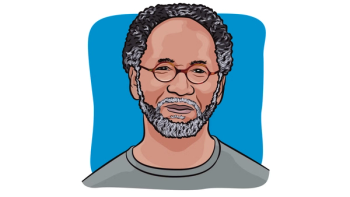
Author(s)Chester Freeman
A reflection on shame, vulnerability and transformation, exploring how the past shapes us and how presence can help us let go and heal.
Advertisement
I was a sharp-edged young man. I had not grown or matured enough to lose my sharp edges, as happens to a piece of drift wood.I was defensive, easily wounded, and quick to return the wound. Growing up with physical differences that set me apart from my peers — and carrying the weight of shame about those differences — made me hypervigilant. I was always scanning the room for the person who might look at me too long, who might ask the wrong question, who might make a joke at my expense. I built elaborate defenses. I became expert at deflection and humor, at changing the subject before it could change me.
But defenses are exhausting to maintain. And slowly, over the decades, I began to let some of those defenses down. Not all at once. There was never a single dramatic moment of breakthrough. It was more like the process of the ocean working on driftwood: gradual, persistent, patient. A conversation here, a moment of unexpected kindness there. A relationship that required me to be more honest than I was comfortable being. A grief that broke me open in ways I hadn’t anticipated, and that left me — to my surprise — more alive than I’d felt in years.
The psychologist Bréné Brown writes about vulnerability as the birthplace of connection. She argues that the stories we are most ashamed of are often the very stories that connect us most deeply to other people, because everyone has their own version of that story — their own scar, their own shame, their own carefully guarded secret. I didn’t read her work until I was well into my sixties, but when I did, I felt as though she had described something I’d spent a lifetime slowly learning. The sharp edges I’d used to keep the world at bay were also keeping me from the connections that would have healed me.
I’m always amazed by the holes and crevices in driftwood which were made by insects that are no longer present. This reminds me that my past is behind me. Yesterday is over and it doesn’t help me to dwell on it. It’s much better to focus on the here and now and to be present in the moment!
Those small tunnels bored into the wood by beetles and wood borers are evidence of a life that was lived and then departed. The insects that made them are gone, but the tunnels remain as a testament to their industry. I think there is something important in that image. Our past experiences — even painful ones — leave marks in us. They are part of our structure. They cannot be erased and we wouldn’t be who we are without them. But the creatures that made those marks — the fears, the shames, the angers, the griefs of particular moments — those don’t have to live in us forever. They can move on. We can let them go.
One of the spiritual practices I’ve found most useful in my later years is what contemplative teachers call “presence.” It sounds simple, and in some ways, it is. It means placing your full attention on what’s happening right now, in this moment, rather than rehearsing the past or rehearsing the future. But for those of us who’ve carried heavy burdens of shame or regret, that’s anything but easy. The mind wants to return to the wound. It wants to examine it again, to ask whether it could’ve been avoided, to imagine alternate histories.
Walking the beach has always been, for me, a kind of moving meditation. It’s almost impossible to walk along the ocean’s edge and not be present. The sound of the waves demands attention. The light on the water shifts constantly. The sand moves beneath my feet. My body is engaged, my senses are open, and the mental noise that ordinarily fills every quiet moment recedes. It’s in those moments of presence that I’ve received what I can only call grace — unexpected insights, sudden peace, a feeling of being exactly where I’m supposed to be.
While walking on the beach I found a piece of driftwood that reminded me of the shape of a bird. I could clearly see the bird’s face, body, and wings. As I viewed this wooden sculpture, it made me think of all the transformations it went through to reach this state of beauty. This, in turn, reminded me of another lesson from earlier in my life.
The piece was perhaps eighteen inches long, and it had a particular curve to the main body, with two branches extending from it that formed what I interpreted as wings. The grain of the wood ran through it in long, sweeping lines, somewhat like the pattern of feathers. It was pale silver-grey, almost white. I turned it in the sunlight and something in the angle of the light made the grain shimmer, so that the wings seemed to have a kind of iridescence. I thought of herons, and of pelicans gliding low over the surf, and of all the birds I watched that morning as I walked.
I am generally somewhat of a mystical person. I try to be grounded, to look for practical explanations before I reach for symbolic ones. But standing there on that beach in the summer of 1974, holding that bird-shaped piece of driftwood, I felt something shift inside me. I felt, for a moment, that the wood had something to say to me. And what I heard — or felt, or understood, in whatever non-verbal way these things arrive — was something about transformation. About the possibility of becoming something beautiful precisely because of, and not in spite of, everything I have endured.
For more news on cancer updates, research and education,
Advertisement
Related Content


Advertisement
Advertisement
Trending on CURE
1
Top 3 Takeaways From WCLC 2026 That Patients Should Know
2
A Gift from the Sea
3
New Myeloma Combo Cuts Risk of Relapse by Up to 72% — Here's What It Could Mean for You
4
Enhertu Delays Progression in HER2-Mutant Lung Cancer in Phase 3 Trial
5