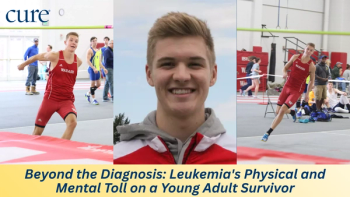
A leukemia survivor recalls how bonding with other patients helped his hospital stays go by faster and became a key part of his emotional healing.
Logan Terry, who has stage 4 ALK-positive lung cancer, encouraged patients with cancer to keep living fully after diagnosis and not be defined by fear or bitterness.
Patients who are newly diagnosed with cancer should try and focus on continuing to live fully rather than becoming consumed by bitterness or fear, according to Logan Terry, who is living with stage 4 ALK-positive non-small cell lung cancer.
Speaking with CURE, Terry reflected on the emotional reality of receiving a cancer diagnosis and how it can permanently alter a person’s perspective and daily life. However, he emphasized that patients still have a choice in how they move forward.
“I would tell them to live,” Terry said. “Nothing is going to go back to normal. This is going to stay with you.”
Terry explained that while cancer changes a person, he believes patients can decide whether to let the experience shape them in a positive or negative way.
“The question is: are you going to wear it as a badge of honor and use it as a tool to make you a better person, or are you going to become bitter about the situation and the cards you have been dealt?” he said.
Terry said experiences like that reinforced an important reality about cancer: the disease does not discriminate.
“Cancer does not care if you are 2 or 102,” he said. “It will change who you are. But do not let it make you bitter about the cards you have been dealt.”
What advice do you have for a patient who might be newly diagnosed or thinking, ‘this is it’?
I would tell them to live. Nothing is going to go back to normal. This is going to stay with you. The question is: are you going to wear it as a badge of honor and use it as a tool to make you a better person, or are you going to become bitter about the situation and the cards you have been dealt?
We do not always get to choose. As a matter of fact, when we got the news, we had a nurse at Barnes-Jewish — I believe her name was Alexa — who actually went out and bought me dinner because I wanted something special. She brought it to me, but that is an aside.
After the diagnosis, she hugged us and cried. She said, ‘Why did this happen? You guys are such nice people.’ But cancer does not discriminate. It does not care if you are 2 or 102, and it will change who you are. But do not let it make you bitter about the cards you have been dealt. That is the advice I would offer.”
Transcript has been edited for clarity and conciseness.
For more news on cancer updates, research and education,