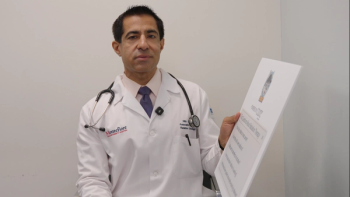
Dr. Nitin Ohri explains how radiation treats cancer, how often treatment is needed, common side effects and how to tell if radiation is working.

Cara Curcio’s melanoma journey changed her life as a wife and mother, but treatment, family and hope have kept her moving forward.
Before cancer, Cara Curcio was used to being the person who kept everything moving.
She was a wife, a mother of three and a professional with a demanding corporate career. Her days were filled with long hours at work, daycare drop-offs and pickups, family responsibilities and whatever time she could find for her husband and children. Life was busy, but it was also full of the things she loved.
Today, Curcio is not only living with metastatic melanoma but also a Skin Cancer Warrior with The Skin Cancer Foundation, using her experience to help raise awareness and support others affected by skin cancer.
Then, in August 2021, Curcio’s life changed when a spot on her scalp turned out to be melanoma.
At first, she thought the spot was nothing. But after a biopsy, her dermatologist told her that she had stage 2 melanoma. Curcio remembers becoming overwhelmed almost immediately. Her mind quickly went to her children and husband and what her diagnosis could mean for the family she was responsible for.
At the time, Curcio was in her late 30s and the main breadwinner for her family. The possibility that she might not be there to raise her children was terrifying.
She called her husband, who was golfing when she received the news. He immediately left and came home, and together they began figuring out how they would face the diagnosis.
What they did not know yet was that the hardest part of Curcio’s cancer journey was still ahead.
Curcio’s melanoma eventually progressed to stage 4. Her initial experience with her hometown oncologist left her and her husband feeling that they needed another option, so they sought a second opinion in New York City.
That decision gave Curcio something she desperately needed: a treatment plan and a reason to believe there was still a future to fight for.
Her new oncologist laid out several possible approaches, giving Curcio and her husband a sense that they were no longer simply waiting to see what would happen.
Until that point, the uncertainty had been overwhelming. The couple had even begun thinking about wills and writing letters for their children to read as they grew older.
Once treatment began, however, Curcio could focus on taking the next step.
She started immunotherapy and saw tumors throughout her body shrink. She had between 20 and 30 tumors, but the treatment produced a significant response. Because her melanoma was BRAF-positive, she later moved to a targeted therapy.
About a year and a half later, she reached no evidence of disease.
For a mother who had spent years worrying about whether she would be there for her children, being told that there was no evidence of disease offered a chance to return to something resembling normal life.
But that period did not last forever.
Toward the end of 2024, Curcio learned that her melanoma had returned, this time in her brain.
She underwent surgery to remove a brain tumor, but a subsequent scan revealed three additional tumors. Once again, she and her family had to adjust to a new reality.
Curcio eventually began treatment through a clinical trial. The treatment has been working, with the tumors in her brain shrinking, although they remain present. She continues to travel for treatment every three weeks.
Through all of this, Curcio has also continued being a mother.
When she was first diagnosed, her children were 4, 6 and 12 years old. Her husband helped explain the diagnosis to them, tailoring the conversation to their ages. The younger children initially understood that their mother was sick and needed doctors to help her.
As the years passed, they saw more of what cancer meant. They watched their mother lose her hair, undergo surgeries and travel for treatment.
Today, Curcio’s children are 9, 11 and 17.
One of the hardest parts for them has been the time apart from their parents when Curcio travels for treatment. Still, she has watched her children grow into remarkably resilient people.
And they remain one of the biggest reasons she keeps going.
Curcio’s cancer journey also changed her understanding of what it means to accept help.
Before cancer, she was accustomed to taking care of everyone else. During treatment, she had to allow other people to take care of her.
Her husband has been beside her throughout the journey, attending appointments and scans and supporting her through each new development. Her friends and extended family have also stepped in, making meals, caring for her children and helping with everyday responsibilities when Curcio could not manage them herself.
She describes the people around her as an enormous village.
That support has helped her continue being present for her family, even when cancer has made life look very different from the one she knew before her diagnosis.
Curcio’s cancer journey has included multiple diagnoses, changing treatments, surgeries, recurrence and a clinical trial. But at its heart, it is also the story of a woman trying to remain a wife and mother while living with a disease that repeatedly threatened to take those roles away from her.
Cancer forced her to confront the possibility that she might not get to watch her children grow up. It also taught her that she did not have to face that possibility alone.
Today, Curcio continues treatment and continues making the long trips required for her clinical trial. She continues to be a mother, a wife and the person her family depends on, even if being that person looks different now.
Looking back at the woman who first heard she had cancer, Curcio wishes she could tell her something she had difficulty believing at the time: There is hope.
There are treatments to try, new options to consider and reasons to keep moving forward.
For Curcio, that hope is not an abstract idea. It is found in her children, in her husband, in the people who have carried her through the hardest moments and in the possibility of more time with the family she has spent her life taking care of.
For more news on cancer updates, research and education,