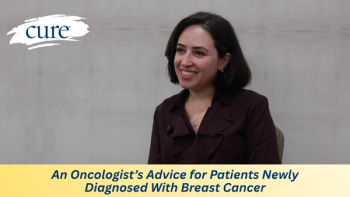
Dr. Elham Vosoughi, a breast medical oncologist at UCSF, discusses new breast cancer treatments, clinical trials and why genetic testing matters for families.
Claudine Joseph, board president of Bay Area Cancer Connections, shares her mother’s breast cancer experience and why peer support matters for all patients.
Shortly after a breast or ovarian cancer diagnosis, many patients turn to their doctors or internet searches for answers. Claudine Joseph, board president of Bay Area Cancer Connections (BACC), told CURE that patients also need people who have been through the experience themselves.
Joseph saw that need firsthand when her mother was diagnosed with breast cancer during Joseph’s senior year of college.
“She is the breadwinner for my family. And her biggest concern was less about how to take care of herself, but how to keep taking care of her family during this,” Joseph said.
Her mother leaned on her church for support but relied on her doctor or her own research for most of her questions, Joseph noted.
“What I wish she had at the time, and I’m happy to know exists for others, is that community, people who are looking out for you just as much as you’re looking out for others,” she said.
Joseph added that information alone is not always enough, because patients also benefit from guidance shaped by lived experience.
“Sometimes you need someone who knows what they’ve been through, someone who’s been through experiences themselves to be a guide for them as well,” she said.
From its base in San Mateo, BACC sends a mobile resource center called Tiffany, named for its Tiffany blue color, to events around the region with bras, wigs and information about the care available through the organization. According to Joseph, Tiffany traveled into the Central Valley this past fall, and BACC is looking at a potential expansion into Sacramento.
“I see you, I feel for you, and you have a home. You have a home in BACC,” Joseph said. “You can reach out in any capacity, in any way, with any question. There are people here who can help.”
She also encouraged patients to remember that a diagnosis is one part of their story rather than the whole of it.
“I think for some people, they think that they are defined by their status as [a patient with cancer], but that’s just one part, and it’s only part of your journey, not [the] end-all, be-all of who you are,” Joseph said.
For more news on cancer updates, research and education,