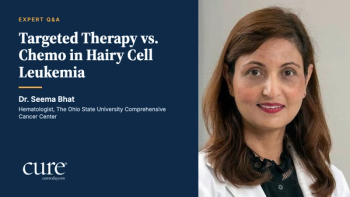
Ohio State hematologist Dr. Kerry Rogers says chemotherapy and newer targeted drugs both work well, and the right choice depends on the patient.
An expert from Case Western Reserve University explains how cancer cells survive treatment, why rare diseases are hard to study and why CAR-T therapy offers hope.
Some patients with cancer respond well to chemotherapy, while others do not — or respond at first, then stop responding when the disease relapses. Dr. Reshmi Parameswaran, an associate professor in the Department of Medicine at Case Western Reserve University in Cleveland, studies why in order to develop new immunotherapy strategies, including for hairy cell leukemia.
In an interview with CURE at the Hairy Cell Leukemia Foundation (HCLF) scientific meeting, Parameswaran explained that cancer cells in patients who do not respond, or who develop resistance, receive additional survival signals that protect them from chemotherapy-induced cell death.
“They have some additional survival signals, and they are too happy to be there, and they can live longer,” she said.
Identifying those signals is the first step, she noted. Once researchers understand how the cells survive, they can develop drugs that block those factors and make patients sensitive to chemotherapy again.
The rarity of hairy cell leukemia makes that work harder. Parameswaran explained that rare diseases draw less interest from large drug companies and that researchers struggle to collect enough patient samples. When she contacted hospitals, some told her they had only three or four — not enough for a study.
She credited the HCLF with helping close that gap. The foundation provides research funding and hosts an annual meeting where scientists and clinicians discuss challenges, hear patient perspectives and form collaborations. If she needs to learn how to grow hairy cell leukemia cells from patients, for example, she can find a colleague there who knows how.
“Without the [Hairy Cell Leukemia] Foundation, I think this kind of work is impossible,” Parameswaran added.
As for what comes next, she pointed to chimeric antigen receptor (CAR) T-cell therapy — a treatment that reprograms a patient’s own immune cells to recognize cancer — as a source of hope for both classic and variant hairy cell leukemia. Some CAR T-cell therapies are already in clinical trials open to interested patients, she noted, and others are coming, including one her team plans to take into a clinical trial.
“There is hope, and for sure it’s going to do magic for patients,” she said.
For more news on cancer updates, research and education,