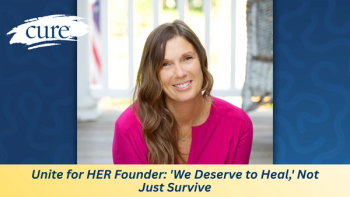
Sue Weldon, a 22-year breast cancer survivor and Unite for HER founder, explains how integrative therapies helped her heal after chemotherapy.
Author and survivor Parul Somani shares how patients with breast cancer can find peace of mind when clinical certainty is missing.
For many patients diagnosed with breast cancer, the immediate aftermath is a whirlwind of clinical data, survival statistics, and a desperate search for the "right" answer. However, Parul Somani, an MIT- and Harvard-trained strategist and breast cancer survivor, argues that in the face of extreme medical uncertainty, certainty is often an illusion.
In her new book, "The Path of Least Regret," Somani draws on her professional expertise and personal journey to offer a framework for decision-making when the stakes are high and the data is incomplete. Diagnosed with aggressive breast cancer at age 31, just days after an emergency C-section, Somani found herself forced to make life-altering choices while her newborn was in the NICU.
Somani emphasized in an interview with CURE that the first step in navigating a diagnosis is emotional honesty. Before diving into treatment plans, patients must acknowledge the grief and fear that naturally accompany the news. While hope is vital, Somani notes that "hope isn't a course of action." True empowerment comes from seizing control of the factors within a patient’s reach.
The core of Somani’s approach involves three pivotal questions designed to provide clarity:
Somani reframes regret not as a failure to avoid, but as a tool for navigation. When "guarantees" do not exist, the goal shifts toward making decisions that the patient can live with, regardless of the eventual outcome. By focusing on meaning, agency, and self-trust patients can move forward with the confidence that their choices were rooted in their own unique values.
For more news on cancer updates,research and education,