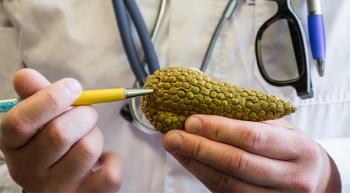
The Whipple procedure is the main operation for cancer in the head of the pancreas. Here is what is removed, what the hospital stay is like, the complications to know about and how eating changes afterward.
For World NET Cancer Day, CURE answers seven common questions about neuroendocrine tumors, from carcinoid syndrome and Ki-67 to dotatate PET scans and treatment options.
Many people living with a neuroendocrine tumor heard the term for the first time on the day they were diagnosed. These tumors are rare, can start in many parts of the body and are often found by accident during a scan or surgery for something else, Dr. Pamela L. Kunz, a medical oncologist at Yale Cancer Center, explained in a
Nov. 10 is World NET Cancer Day, and November is Carcinoid and Neuroendocrine Tumor (NET) Awareness Month. These answers draw on the National Cancer Institute (NCI), the American Cancer Society (ACS) and FDA drug labels.
Yes. NETs start in neuroendocrine cells, which can make and release hormones. The ACS describes gastrointestinal NETs as cancers "referred to in the past as carcinoid tumors." Most NETs start in the digestive tract, but they also form in the pancreas and lungs.
The ACS notes that "NETs are often slow growing, but some are not and can possibly spread to other parts of the body." About half of pancreatic NETs make enough hormones to cause symptoms (called "functioning" tumors).
Carcinoid syndrome is a set of symptoms caused by hormones, such as serotonin, that some NETs release. According to the NCI, it often happens when a tumor has spread to the liver, which normally breaks down these hormones. Symptoms include flushing of the face and neck, belly pain, bloating, diarrhea, wheezing and a fast heartbeat.
Doctors often check for it with a 24-hour urine test for 5-HIAA, a substance the body makes when it breaks down serotonin. A blood test for chromogranin A, a protein many NETs release, helps with diagnosis and tracking.
Grade describes how quickly tumor cells are growing. Pathologists look at the mitotic count (how many cells are actively splitting) and the Ki-67 index (the share of cells getting ready to split).
Per the ACS, well-differentiated NETs, whose cells look more like normal cells, generally have a Ki-67 index of 20% or lower. Tumors above 20% are grade 3. Most grade 3 tumors are poorly differentiated neuroendocrine carcinomas, which "often grow and spread quickly" and are treated differently. Occasionally a well-differentiated tumor has a Ki-67 above 20%, so the full report matters more than a single number.
Many NETs carry proteins called somatostatin receptors. A somatostatin receptor PET scan uses a tracer, such as gallium-68 or copper-64 dotatate, that acts "like a homing signal" and attaches to those receptors, lighting up tumor sites, the ACS explains. It works less well for high-grade tumors and those that overproduce insulin.
The scan also shows whether receptor-targeting treatments are likely to help. "It helps determine where the tumors are and informs your decisions of where you want to go with therapy," NET patient advocate Jennifer Zuniga told CURE in a
Surgery is used when a tumor can be removed. For advanced NETs, somatostatin analogs (lab-made versions of a natural hormone) are a mainstay. Sandostatin LAR (octreotide), an injection into the muscle every four weeks, is approved for severe diarrhea and flushing from metastatic carcinoid tumors. Somatuline Depot (lanreotide), a deep injection under the skin every four weeks, is approved to slow advanced gastroenteropancreatic NETs and to treat carcinoid syndrome. Side effects include injection-site reactions, belly pain and gallstones.
Lutathera (lutetium Lu 177 dotatate) delivers radiation directly to cells with somatostatin receptors. It is given by IV every eight weeks for four doses, was approved for adults in 2018 and was expanded in April 2024 to patients 12 and older. Its label warns about low blood counts, kidney effects and infertility.
Targeted pills include Afinitor (everolimus) and, for pancreatic NETs, Sutent (sunitinib). In March 2025, the FDA approved Cabometyx (cabozantinib) for previously treated advanced well-differentiated NETs. In its trial, people with pancreatic NETs lived a median of 13.8 months without their cancer worsening, versus 3.3 months on placebo (an inactive pill); for NETs outside the pancreas, it was 8.5 versus 4.2 months.
For some, life with a NET looks more like managing a long-term condition. The NCI notes that care for a small, slow-growing nonfunctioning pancreatic NET may begin with active surveillance, meaning regular scans instead of immediate treatment.
Per ACS data on people diagnosed from 2015 to 2021, the five-year relative survival rate for grade 1 or 2 gastrointestinal NETs was 94% across all stages, and 68% when tumors had spread to distant organs. These figures do not reflect the newest treatments or any one person's outlook.
Because NETs are rare, studies are small. Lutathera's approval for teens rested on safety data from nine young patients, and the FDA required a longer-term study. The ACS notes that "better treatment approaches are needed when surgery can't remove all the tumors," and immunotherapy for NETs is still being studied.
A practical next step: ask whether a NET specialist has reviewed your case, as Kunz recommends, and keep your own copies of every pathology report and scan, including the grade and Ki-67.
For more news on cancer updates, research and education,