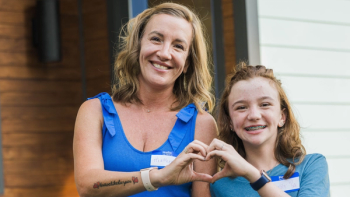
Diagnosed with leukemia at 8 years old, Harper feared that losing her hair would change who she was. She reflects on body image, confidence and finding a sense of herself during cancer treatment.
Partnering with Lilly on a clinical trial awareness campaign, the actor reflects on his grandmother's record-setting survival and the simple message he wants every patient to hear.
Rob Lowe has been advocating for cancer patients since 2003, when he became what he says was the first male spokesman for breast cancer awareness. The cause is personal. His grandmother was a breast cancer patient who was told to get her affairs in order twice before clinical trials extended her life — ultimately making her the longest-surviving patient with breast cancer of her time at the Cleveland Clinic.
Now partnering with Lilly on a campaign to change the way patients with cancer approach clinical trials, Lowe sat down with CURE to talk about growing up in a family shaped by cancer, why he believes patients should be asking about trials at diagnosis rather than as a last resort and what his grandmother would say to someone who is afraid.
Lowe: With the caveat that I was really young when this first started — so there are a lot of details I don't remember — but the fact that I remember it at all at that age speaks to how disruptive, scary and uncertain it is when something like this makes its way down through the generations of a family.
She was told to get her affairs in order twice, and both times, this new drug she was put on prolonged her life. When she did pass, she was the longest surviving breast cancer patient of her time at the Cleveland Clinic.
Lowe: I have seen the highs and the lows, the hope and the promise. When my grandmother was diagnosed with breast cancer, the standard of care was a double mastectomy. That was it, boom, you're done. It's insane to think about today.
My dad is a two-time non-Hodgkin's lymphoma survivor. He's going to be 87 in September and he's doing great. And what I've really learned through all of it is that we need more people participating in trials. With my grandmother, it was: nothing else is working, we're at the end of possibilities, let's do this. What people will realize is you can do it immediately and you're still going to get the exact same care — but better, because you're going to have an entire new set of eyes, ears and brains on your case.
Lowe: From the time I was 8, 9, 10 years old, it was really formative all the way through my adolescence. The feeling of it was like an intruder lurking around the house — sometimes we were able to keep it out, and other times it felt like it was breaking in.
It hugely affected my relationship with my grandmother, who I adored. We were extraordinarily close. Mortality is not naturally a part of childhood, but it was for me, because I knew my time with her could be very limited.
Lowe: When I was approached by Lilly, I immediately said yes. I get so much out of this work — in memory of my grandmother, my family — and the hope and strength you get from the people you meet doing it, the perspective on life, you truly can't buy that anywhere else.
But I have to say, when they told me the numbers, I was stunned. I think we are in single digits in terms of how many newly diagnosed patients talk to their doctor about the possibility of clinical trials. Those numbers are insane. I believe the U.S. has some of the lowest rates in the world. We have to get the word out.
Lowe: A few things. First, a clinical trial is not only for people who have run out of options. It is for people at every step of their journey, and you should be considering it at the very beginning. There are plenty of people who benefit immediately.
The other thing I hear a lot is the fear of getting a placebo. What I would say is: you are going to get the exact same care you would be getting anyway. You truly have nothing to lose and everything to gain. Being in a trial invites in this remarkable group of researchers and doctors that you would not otherwise have access to — and the more people who participate, the faster we get to the next generation of treatments. It is a very simple message.
Lowe: We have the best doctors in the world, but nobody can advocate for your health like you. Doctors have a lot on their plate, and it is on the patient to take control of their treatment. I have so much sympathy for people who cannot do that on their own.
Bring a recorder to your doctor's appointments — or just record on your phone. I get it, it is overwhelming. There is so much technical information coming at you and you are already emotionally unmoored. You do not fully process it in the room. So go home, listen back, write your questions and go back to your doctor. Treat advocating for yourself like your life depends on it. Because it does.
Lowe: She would say she understands. She would say yes, the whole journey is scary — but this part of the journey need not be, because it does not change anything for the negative. Whatever your fate, whatever your journey, whatever your treatment, nothing changes. It only potentially gets better.
For more news on cancer updates, research and education,