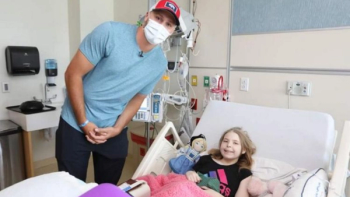
Hannah was 11 when she was diagnosed with acute lymphoblastic leukemia (ALL). Four years, two relapses and a 53-day hospital stay later, she is back in school.
MosunPola improved progression-free survival and response rates over R-GemOx in transplant-ineligible relapsed large B-cell lymphoma.
For patients with relapsed or refractory large B-cell lymphoma who are not candidates for stem cell transplant, treatment options have long been limited — and outcomes, historically poor. Results from the phase 3 SunMo trial suggest that may be changing. The study evaluated mosunetuzumab plus polatuzumab vedotin (MosunPola) — a chemotherapy-free combination of a bispecific antibody and an antibody-drug conjugate — against the older chemotherapy regimen R-GemOx, and demonstrated significant improvements in progression-free survival and overall response rate.
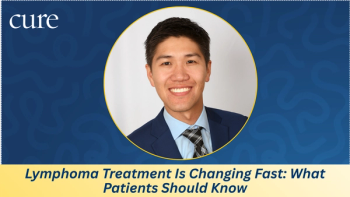
Notably, the regimen was administered as a fixed-duration, fully outpatient therapy, with a favorable safety profile even in older and frailer patients. Dr. Jason Westin, director of lymphoma clinical research at MD Anderson Cancer Center, spoke with CURE about the trial’s findings, what they mean for this underserved patient population, and how the combination could reshape the treatment landscape going forward.
Westin: Patients with relapsed/refractory large B-cell lymphoma who are ineligible for transplant have historically had very poor outcomes. It wasn’t that long ago that transplant was the only curative option we had, and so patients who were ineligible because of age, frailty, or comorbidities were treated with approaches that were largely palliative. This has been a large unmet need.
The SunMo trial was evaluating the novel combination of mosunetuzumab and polatuzumab — not conventional chemotherapy, but a bispecific antibody and an antibody-drug conjugate — randomized versus an older chemotherapy regimen, R-GemOx, trying to give these transplant-ineligible patients effective and safe therapy that can improve their outcomes.
The efficacy finding that stood out most to me was the improvement in progression-free survival. Responses measured based on PET scans and physical exam are very important for patients with large B-cell lymphoma, but if those responses don’t last — if they’re not durable — they’re not as meaningful. When we look at what’s most meaningful to our patients, having a response that holds, that lasts, that stands the test of time, that’s what patients really want to see. In the SunMo trial, we saw a dramatic improvement in progression-free survival for MosunPola. This is a fully outpatient regimen — no hospital admission required — and the side effect profile was quite well tolerated, which I think we’ll touch on in just a moment.
The improvement in progression-free survival was statistically significant over the older chemotherapy R-GemOx, which is what we believe is the most important finding in this phase 3 study.
The fully outpatient, fixed-duration approach validated in the SunMo trial is really important for our patients. Bispecific antibodies are a new class of therapies that have been, I’d say, a breakthrough for patients with aggressive B-cell lymphomas, but many of them require hospital admission — usually for one, maybe a couple of treatments. Anytime someone has to spend a night in the hospital, it’s disruptive for patients, their families, and healthcare systems.
The advantage of mosunetuzumab, first, is that there is no hospital admission unless a patient has significant toxicities, which were thankfully very rare on this trial. The other advantage is that it’s a fixed-duration treatment. Some treatments are ongoing until a patient either has disease progression or side effects that require stopping, but mosunetuzumab has a prescribed number of treatments, after which the plan is to stop — and that’s important for our patients who want to turn the page and get back to their lives. In this clinical trial, the fully outpatient, fixed-duration MosunPola treatment was highly effective and allowed patients to do just that.
When we’re looking at new treatments for our patients, we always focus on the good part — how effective is the treatment, what are the response rates, what is the progression-free survival — but it’s also very important to focus on the less good part: the side effects, or what the treatment “costs” in terms of burden for our patients. One of the key side effects we look at with bispecific antibodies is cytokine release syndrome.
This is a common reaction seen with treatments like CAR-T cell therapy, where the patient develops a high fever and sometimes low blood pressure or organ dysfunction — rarely life-threatening, and thankfully reversible — but it can be a limiting factor in the ability to receive treatments like CAR-T or sometimes bispecific antibody therapy. In the SunMo trial, we found that MosunPola has a very low rate of cytokine release syndrome. About a quarter of patients experienced any degree of cytokine release syndrome, but most of that was just a fever that resolved with no further side effects. Less than 5% of patients had anything beyond a fever — meaning 95% of patients did not have any significant cytokine release syndrome on the SunMo trial. So while it can occur, significant cytokine release syndrome is very, very rare with this treatment.
Based on the promising results from the SunMo trial, I believe this should be a new standard-of-care option for patients with relapsed/refractory large B-cell lymphoma who are ineligible for transplant. This will expand the number of treatment options available to patients with this difficult-to-treat disease, and it can be given at sites that have historically not been able to deliver highly effective therapies like bispecific antibodies or CAR-T cell therapies. Many of our patients live in rural communities or far from tertiary cancer centers and are not able to travel to receive care at one of these large institutions — and therefore don’t have access to these breakthrough therapies.
MosunPola can be given, in my opinion, in a wide range of treatment settings, including those not attached to a major cancer center, which should expand access to highly effective therapy for more patients with relapsed/refractory large B-cell lymphoma, including those ineligible for transplant. Being both highly effective and safe, this treatment has a significant role to play in our arsenal against large B-cell lymphoma.
If a patient is newly diagnosed with relapsed large B-cell lymphoma, it’s important to talk to your doctor about all the treatment options. There are, thankfully, a number of new treatments approved by the FDA, and even more available through clinical trials.
Sometimes an older treatment is the best option, but sometimes newer options are available — and if you don’t ask your doctor about MosunPola, or CAR-T cell therapy, or clinical trials, you may not gain access to the treatments that are really changing how we treat this disease, prolonging survival, improving quality of life, and benefiting more and more patients. So ask: What other treatment options are available? Your doctor will be able to direct you to the best treatments for you.
For more news on cancer updates, research and education,