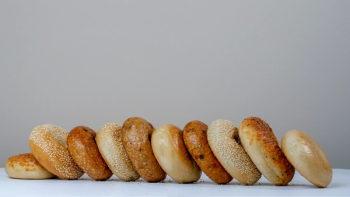
A wife reflects on her husband’s cancer treatment, finding comfort, hope and connection in their simple ritual of sharing bagels before each treatment.
Explore the complexities of Mother’s Day and clinical trials. Learn how research offers hope and different outcomes for patients facing ovarian cancer.
Every year, as Mother’s Day approaches, we see the same messages.
Celebrate your mom.
Call her.
Hug her.
Don’t take her for granted.
And yet — for so many — that hug is no longer possible.
There is a quiet grief that lives inside this day.
Because as long as our parents are alive, a part of us remains a child — protected, grounded, held by something bigger than ourselves.
And when that is gone … something shifts forever.
Years ago, while working on an ovarian cancer clinical trial, I met a woman I will never forget.
She was 46 years old.
A mother of four.
Her cancer had already spread — to her abdomen, her brain. The disease had moved quickly, aggressively. We enrolled her into the trial, holding onto what we always hold onto in research: Hope.
Because clinical trials are, at their core, a chance.
Not a guarantee — but a chance.
But her body did not respond.
And she passed away.
Around the same time, we had another patient.
She was 74 years old.
Also a mother.
Also on the same trial.
Same drug.
Her tumors began to shrink.
She responded.
Two women.
Two mothers.
Same diagnosis. Same treatment.
Completely different outcomes.
This is the reality of clinical research.
This is the reality of life.
Fragile. Unpredictable. Unfair at times.
I remember one moment so clearly.
It was a Friday — just before Mother’s Day.
I was sitting by the window at work when we received confirmation that the younger woman’s disease had progressed.
Outside, the sky was a perfect blue.
The sun was shining.
A soft breeze moved through the air.
People were walking to meetings. Life was moving forward.
And all I could think about … were her children.
Four kids.
I kept thinking: This may be the last Mother’s Day they will have with her.
At the time, my own daughter was just 2 years old.
And suddenly, Mother’s Day felt different.
It wasn’t just a holiday anymore.
It was a moment.
A privilege.
A fragile, irreplaceable moment between a mother and her child.
Because Mother’s Day is not only about celebrating mothers.
It’s about the moment a woman becomes one.
And the moment a child gives her that identity.
It’s their day, too.
Those four children would grow up without her.
Without her at birthdays.
At graduations.
At weddings.
Without her holding their children one day.
All of those moments … changed by one diagnosis.
After nearly 20 years in clinical research, this is what I’ve come to understand: Life should not be measured only in milestones.
It should be measured in moments.
In hugs.
In laughter.
In ordinary days that feel insignificant — until they’re not.
Just yesterday, I watched three generations sit together — my mother, my daughter and me.
And I thought: This is everything.
This is what so many people are missing.
So this Mother’s Day, my wish is simple:
If you can — hug your mother.
If you are a mother — hold your child a little longer.
Celebrate the moment.
Don’t rush it.
Don’t assume there will always be another one.
And if life ever places you in a position to consider clinical research — as a patient, a participant or even as someone supporting it — know this: You are not just part of a study.
You are part of a chance.
A chance for more time.
More memories.
More Mother’s Days.
Because behind every clinical trial …there is a mother.
Regina Portnoy is a clinical research professional with 20 years of experience in pharma and biotech, specializing in hematology and oncology.
This piece reflects the author’s personal experience and perspective. For medical advice, please consult your health care provider.
For more news on cancer updates, research and education,