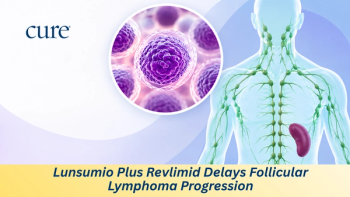
Lunsumio added to Revlimid kept relapsed or refractory follicular lymphoma from worsening longer than Rituxan plus Revlimid in the phase 3 CELESTIMO trial.
Now that I have been living with my chronic cancer for 16 and a half years, I’ve been reflecting on how my attitude has changed over time.
Now that I have been living with my chronic cancer for sixteen and a half years, I’ve been reflecting on how my psychological attitude has changed over time. When I first heard my diagnosis, I was devastated. Every breath, every moment, every bite of food reeked of cancer thoughts. It was overwhelming and difficult to process, especially after being told there was no cure and that I would have to live with this disease beside me for the rest of my life.
I read that the average life expectancy with my diagnosis was ten years. At the time, my three daughters were young adults, and marriage wasn’t even on the horizon for any of them. I couldn’t bear the thought of living every day consumed by the fear that I might not be alive to experience the joy of grandchildren, or simply the unfolding of their lives.
I had to figure out a way to survive psychologically without losing my mind or my zest for life.
I survived by compartmentalizing my thoughts because, honestly, I didn’t know how else to cope. I began to recognize the fear I was carrying and realized I had to do something with it. I couldn’t continue living the way I was. I wasn’t fully present in my life with this diagnosis hovering over every step I took. I needed to learn how to compartmentalize fear.
The fear is still there without question but that doesn’t mean it gets to win. Like my attitude toward this diagnosis, I have the power to choose how I respond to it.
Along the way, I came across a teaching from Ben Sira, a Jewish sage from the second century BCE, that deeply resonated with me. He warns: “Do not suffer from tomorrow’s trouble…for you do not know what a day will bring.” I am grateful to Rabbi Angela Buchdahl for introducing this teaching to me in her book Heart of a Stranger.
The anxiety I felt about my future was very real, but suffering over it felt futile. I have absolutely no control over what the future will hold. With new research continually emerging, it is even possible that one day there could be a cure. I had to ask myself: Was I bringing this fear upon myself? Was there a way to reframe it so I wasn’t actively feeding it?
Ben Sira’s teaching poses a stark reminder: none of us knows how long we will live. So why should I worry about tomorrow when I have no idea what tomorrow will bring: positive or negative? Rabbi Buchdahl suggests that this teaching reminds us of our impermanence and encourages us to be fully present. In doing so, it may help quiet the relentless “what ifs” that dominate our thoughts.
Rabbi Buchdahl also shares that her mother is Buddhist, a tradition that promotes a similar philosophy: that we should not judge a moment as good or bad before understanding how it fits into the whole of our experience. There’s also the familiar saying that something bad can turn out to be a blessing in disguise. Many people say that a cancer diagnosis has changed them for the better, regardless of how much time they have left.
No one knows when they will die, but we all know that we will die someday. Sometimes, the transformation that follows a cancer diagnosis can mean living the rest of your life more fully than if you had died suddenly, never given the opportunity to change, reflect, or grow.
What I am really trying to say is fear does not have just one outcome. You get to decide how you respond to it, and there may be many possible outcomes—not just the worst-case scenario.
Will you have to lie to yourself at first? Maybe. Will you have to pretend to place fear on the back burner before it truly feels that way? Possibly. I know I did. But sometimes survival requires practicing something before it feels real.
Rabbi Buchdahl reminds us that life can feel unstable and unforgiving, especially when you are living with uncertainty that never fully disappears. But I’ve learned that when you stop looking too far ahead and focus only on what comes next, placing one foot carefully in front of the other, you begin to find your balance again. Over time, the ground beneath you feels steadier. You realize that even without certainty, you are still moving forward, still living, and still standing.
This piece reflects the author’s personal experience and perspective. For medical advice, please consult your health care provider.
For more news on cancer updates, research and education, don’t forget to