









Patients with HR-positive, HER2-negative high-risk early breast cancer tended to experience improved invasive disease and distant relapse-free survival after adding Verzenio to endocrine therapy.
Patients with HR-positive, HER2-negative high-risk early breast cancer tended to experience improved invasive disease and distant relapse-free survival after adding Verzenio to endocrine therapy.

In this on-demand webinar series, CURE partnered with Look Good Feel Better to discuss skincare during cancer treatment to assist patients in their daily routine.

In this on-demand webinar series, CURE partnered with Look Good Feel Better to discuss eyebrow shaping techniques and applying eye shadow and mascara to address appearance-related effect from cancer treatment.

In this on-demand webinar series, CURE partnered with Look Good Feel Better to discuss lip care as part of one’s makeup routine to address appearance-related effects from cancer.

Patients with previously treated advanced neuroendocrine tumors who received treatment with Cabometyx had improved progression-free survival compared with placebo.

Cancer forced me to face my mortality — and in doing so, I crafted a bucket list and embraced the true meaning of life.

Dr. Gene G. Finley of Drexel University of College of Medicine and AHN Cancer Institute, Allegheny Clinic Medical Oncology, explains why the approval of Braftovi and Mektovi “It's an important improvement in our armamentarium.”

The Food and Drug Administration approved Tibsovo for patients with relapsed or refractory myelodysplastic syndromes with a susceptible isocitrate dehydrogenase-1 mutation.

One expert explains why palliative care for patients with cancer “is about aligning the patient's goals and the family's goals with the therapeutic goals.”

I had to redefine the relationship with my mother during the most challenging of times.
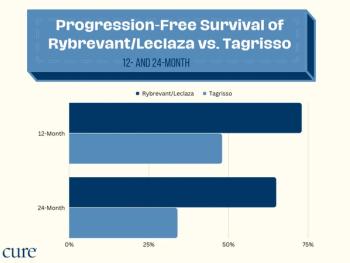
Patients with advanced non-small cell lung cancer with an EGFR mutation had a greater risk reduction for disease progression with frontline Rybrevant plus Leclaza compared with Tagrisso alone.

Central nervous system progression-free survival was shown to improve with Enhertu than with alternative treatments for patients with HER2-positive metastatic breast cancer and brain metastases.
Neoadjuvant Keytruda plus chemotherapy followed by adjuvant Keytruda plus endocrine therapy generated a statistically significant increase in pathologic complete response compared to pre-surgical placebo and chemotherapy followed by adjuvant Keytruda and endocrine therapy for patients with high-risk, early-stage, estrogen receptor–positive, HER2-negative breast cancer.

Patients with metastatic castration-resistant prostate cancer who were never treated with a taxane derived a progression-free survival benefit from treatment with Pluvicto.

Dato-DXd lengthened the average time it took patients with HR-positive, HER2-low or -negative metastatic breast cancer to experience disease progression, study results showed.

Some topics are difficult to talk about. This is one of them.

There are limits and adaptations that are needed during childhood, adulthood and retirement, and I can say the same for every step of my cancer experience.

The addition of Keytruda to Xtandi showed no improvements for radiographic progression-free survival and overall survival in patients with metastatic castration-resistant prostate cancer.

Platinum-based chemotherapy, when administered before chemoradiotherapy, improved progression-free and overall survival for patients with locally advanced cervical cancer.

For the first time, a drug combination (Padcev plus Keytruda) outperformed frontline chemotherapy for patients with locally advanced or metastatic urothelial carcinoma.

The combination of Lumakras and Vectibix led to better progression-free survival compared with standard of care in patients with chemorefractory metastatic colorectal cancer harboring KRAS G12C mutations.

A 30% reduction in the risk of death versus. investigator’s choice of chemotherapy as second or third line therapy was concluded when Tivdak was combined for the treatment of recurrent or metastatic cervical cancer with disease progression on doublet chemotherapy.

Adding Opdivo to a standard-of-care chemotherapy regimen in patients with unresectable or metastatic urothelial carcinoma improved progression-free and overall survival.

Welireg led to improved time to progression and objective response rates compared to Afinitor for patients with advanced clear cell renal cell carcinoma, according to study findings.

Treatment with Retevmo, compared with Cabometyx or Caprelsa, improved progression-free survival and overall response rate in patients with advanced RET-mutant medullary thyroid cancer who were multikinase inhibitor-naïve.

The treatment combination of Rybrevant plus chemotherapy offers better progression-free survival for patients with advanced EGFR exon 20 insertion-positive NSCLC.

Retevmo improved progression-free survival, compared with chemotherapy with or without Keytruda in patients with RET-fusion positive non-small cell lung cancer.

Patients with ALK-positive, early-stage non-small cell lung cancer obtained significant improvement in disease-free survival.

Treating patients with Tagrisso, a tyrosine kinase inhibitor, plus chemotherapy reduced the progression risk of disease of the central nervous system in patients with EGFR-positive non-small cell lung cancer.

Treatment with neoadjuvant Opdivo, followed by Opdivo after surgery led to significantly improved event-free survival in the first phase 3 perioperative study in patients with resectable non-small cell lung cancer.