
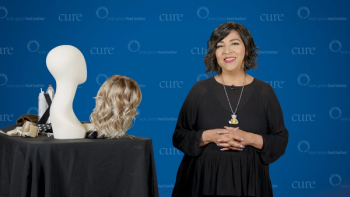
In this on-demand webinar series, CURE partnered with Look Good Feel Better to offer patients with cancer offered tips for haircare and hair loss before, during and after treatment.
In this on-demand webinar series, CURE partnered with Look Good Feel Better to offer patients with cancer offered tips for haircare and hair loss before, during and after treatment.
Linda Ryan, a patient advocate, details her treatment journey with cervical cancer and discusses resources available to patients.

After introducing the panel, Claire Friedman, MD, provides a brief overview of the screening process, prognosis, and treatment of cervical cancer.
Dr. Noor Abuhadra and patient Shay Elkins discuss overcoming barriers to cancer treatment access and reimbursement. Shay shares her relatively smooth experience with insurance coverage, while Dr. Abuhadra emphasizes that healthcare teams will fight for patient coverage, especially when treatments are backed by research and FDA approval. Dr. Abuhadra also mentions having a financial clearance department to handle denials and secure approvals, as well as training staff to fill out prior authorization forms. Shay underlines the importance of self-advocacy and leveraging online communities for both emotional support and practical advice.
Dr. Noor Abuhadra discusses managing adverse events in patients receiving TRODELVY (sacituzumab govitecan), a later-line systemic therapy for metastatic triple-negative breast cancer. Shay Elkins, a patient, shares her experience with significant side effects including diarrhea, low white blood cell counts, and hair loss, while Dr. Abuhadra emphasizes the need for proactive management of these issues to maximize treatment time and maintain quality of life.
This program was possible with support from Bayer.
Reginald Tucker-Seeley, MA, ScM, ScD, concludes the program with advice for caregivers and patients with prostate cancer to maximize the benefit of treatment.
This program was possible with support from Bayer.
Alicia Morgans, MD, MPH, offers advice to patients newly diagnosed with prostate cancer and reviews educational resources available for patients and their caregivers.
This program was possible with support from Bayer.
Practical advice for improving clinical trials to ensure they are more reflective of the overall population of patients with prostate cancer.
Shay Elkins, a patient with metastatic triple-negative breast cancer, discussed her experience with second-line treatment. Dr. Noor provided insights into the positive outcomes from the ASCENT study.
This program was possible with support from Bayer.
Rashid K. Sayyid, MD, MSc, discusses the role of combination therapy in metastatic castrate-resistant prostate cancer.
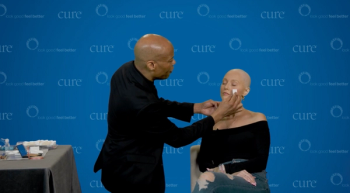
In this on-demand webinar series, CURE partnered with Look Good Feel Better to demonstrate makeup techniques in applying foundation and blush to combat appearance-related side effect from cancer treatment.
In this on-demand webinar series, CURE partnered with Look Good Feel Better to discuss skincare during cancer treatment to assist patients in their daily routine.
In this on-demand webinar series, CURE partnered with Look Good Feel Better to discuss eyebrow shaping techniques and applying eye shadow and mascara to address appearance-related effect from cancer treatment.
In this on-demand webinar series, CURE partnered with Look Good Feel Better to discuss lip care as part of one’s makeup routine to address appearance-related effects from cancer.
Expert oncologists offer closing thoughts on emerging therapeutic strategies, unmet needs, and the future of kidney cancer treatment.
Chandler H. Park, MD, discusses the role of support groups and outlines resources available to patients with kidney cancer.
One expert explains why palliative care for patients with cancer “is about aligning the patient's goals and the family's goals with the therapeutic goals.”
This program was possible with support from Bayer.
Rashid K. Sayyid, MD, MSc, gives a brief overview of treatment options for nonmetastatic castrate-resistant prostate cancer.
This program was possible with support from Bayer.
Expert perspectives on the treatment approach for patients with metastatic castrate-resistant prostate cancer.
This program was possible with support from Bayer.
An expert on prostate cancer gives a brief overview of castrate-resistant prostate cancer.
“When people see me, they just feel like they have to start jogging,” as one chief nurse practitioner tells CURE when discussing how patients with MPNs can reduce their risk of cardiovascular and thrombotic events.
In this on-demand webinar series, CURE partnered with TOUCH, The Black Breast Cancer Alliance to discuss ways patients can be empowered to receive the best care possible.
this on-demand webinar series, CURE partnered with TOUCH, The Black Breast Cancer Alliance to negate common clinical trial misperceptions.
In this on-demand webinar series, CURE partnered with TOUCH, The Black Breast Cancer Alliance to discuss how women of color with breast cancer can learn more about their disease.
In this on-demand webinar series, CURE partnered with TOUCH, The Black Breast Cancer Alliance to discuss low clinical trial participation in Black patients with breast cancer, and factors that may be contributing.
In this on-demand webinar series, CURE partnered with TOUCH, The Black Breast Cancer Alliance to discuss racial disparities in breast cancer.
Tian Zhang, MD, MHS, provides an overview of the treatment of patients with non–clear cell renal cell carcinoma.
An overview of the treatment protocol for patients with advanced RCC who are receiving IO/TKI or IO/IO combination therapy.
Shay Elkins, a patient with triple negative breast cancer, shares her experience of relapse six months post-treatment, eventually leading her to seek a second opinion for her recurring symptoms. Dr. Noor Abuhadra discusses second-line treatment options for metastatic triple negative breast cancer, emphasizing newer therapies like antibody drug conjugates and PARP inhibitors, and highlights the evolving landscape that offers hope for patients.
Dr Noor Abuhadra discusses the various first-line treatment options for metastatic TNBC, highlighting the importance of PDL1 expression for immunotherapy and germline testing for targeted therapies like PARP inhibitors. Patient Shay Elkins shares her treatment journey, from her initial chemo and immunotherapy to surgical intervention, emphasizing the importance of a collaborative approach with her healthcare team and the supportive role of nursing staff.