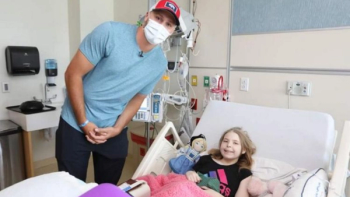
Hannah was 11 when she was diagnosed with acute lymphoblastic leukemia (ALL). Four years, two relapses and a 53-day hospital stay later, she is back in school.
Dexamethasone before Yescarta reduced the severity of ICANS but did not change how often ICANS or CRS occurred in patients with LBCL.
Using dexamethasone before treatment was associated with less severe immune effector cell-associated neurotoxicity syndrome (ICANS) but did not change how often neurotoxicity or cytokine release syndrome (CRS) occurred in people with relapsed or refractory large B-cell lymphoma (LBCL) treated with Yescarta (axicabtagene ciloleucel; axi-cel), according to data from a single-institution retrospective review presented at the 2025 American Society of Hematology Annual Meeting and Exposition.
Further, peak absolute lymphocyte counts was higher in patients who received dexamethasone prophylaxis, and survival outcomes were comparable between groups.
“Our study shows that, overall, there were no significant differences in rates of CRS and ICANS in general with dexamethasone prophylaxis,” said Dr. Christina Darwish, a second-year fellow at Fox Chase Cancer Center at Temple University Hospital in Philadelphia, Pennsylvania, who presented the data. “However, the rates of grade 3 or 4 ICANS were lower among those who did receive dexamethasone prophylaxis.”
No grade 3 or 4 ICANS events occurred in the dexamethasone group versus 25% in the no-dexamethasone group. The total rate of ICANS events was lower in the group that received dexamethasone versus the group that did not.
No grade 2 ICANS events occurred in either group, and 21% versus 13% in the dexamethasone and no-dexamethasone groups, respectively, had grade 1 immune effector cell-associated neurotoxicity syndrome.
Rates of grade 1, grade 2, and grade 3 CRS were 46%, 25%, and 0% in the dexamethasone group versus 38%, 31%, and 0% in the no-dexamethasone group, respectively. Total CRS rates were 71% and 69% in the groups, respectively.
Prolonged follow-up demonstrated an overall response rate of 89% versus 75% in dexamethasone and no-dexamethasone groups, respectively. Complete response rates were 79% and 69%, respectively. Two-year overall survival was 72.2% versus 67.7%, and progression-free survival was 49.9% versus 60.6%, respectively.
Peak median absolute lymphocyte count was 750 cells per microliter versus 500 cells per microliter in prophylaxis and no-prophylaxis groups, respectively. Median time to peak absolute lymphocyte count was shorter in the dexamethasone group at 9.5 days versus 17 days in the no-dexamethasone group.
Median follow-up for the analysis was 21.4 months in the dexamethasone group and 32.5 months in the no-dexamethasone group.
Forty-four patients were treated with Yescarta, and 28 received dexamethasone prophylaxis, although 16 did not. Those who received dexamethasone prophylaxis received the steroid at 10 mg orally on days 0, 1, and 2 after infusion.
Most patients in the dexamethasone group had diffuse LBCL (68%), followed by follicular lymphoma (29%), and primary mediastinal LBCL (4%). No patients in the dexamethasone group had high-grade B-cell lymphoma or marginal zone lymphoma.
In the no-dexamethasone group, 63% had diffuse large B-cell lymphoma, 19% had follicular lymphoma, 13% had high-grade B-cell lymphoma, and 6% had marginal zone lymphoma. No patients in this group had primary mediastinal large B-cell lymphoma.
Patients in dexamethasone and no-dexamethasone groups had a median age of 63 years and 62 years, respectively; 92% versus 73% had Lugano stage 3 to 4 disease; 71% versus 75% had high-grade lymphoma; 18% versus 13% had bulky disease; and 75% of each group received bridging therapy. With regard to lymphodepleting therapy, most patients in the dexamethasone group received bendamustine and most patients in the no-dexamethasone group received fludarabine and cyclophosphamide.
Most patients in the dexamethasone group and no dexamethasone group had an Eastern Cooperative Oncology Group performance status of 0 to 1; 4% versus 6%, respectively, had a score of 2; and 4% versus 0% had a score of 3. Fifty-seven percent of the dexamethasone group was male versus 31% in the no-dexamethasone group.
Yescarta, a cluster of differentiation 19-targeting chimeric antigen receptor T-cell therapy, is approved for the treatment of patients with LBCL relapsed or refractory to chemoimmunotherapy within 12 months of frontline treatment, as well as for the treatment of patients with relapsed or refractory LBCL following 2 or more lines of systemic therapy including diffuse LBCL not otherwise specified, primary mediastinal large B-cell lymphoma, high-grade B-cell lymphoma, and diffuse LBCL occurring as a result of follicular lymphoma.
The agent also received accelerated approval for the treatment of patients with relapsed or refractory follicular lymphoma following 2 or more lines of prior systemic therapy.
According to Darwish, previous concerns have existed regarding the use of steroids in chimeric antigen receptor T-cell therapies due to worry that steroids may limit chimeric antigen receptor T-cell expansion and efficacy following infusion. However, results from a safety cohort of the ZUMA-1 trial revealed that dexamethasone prophylaxis enhanced safety of Yescarta without compromising efficacy.
For more news on cancer updates, research and education, don’t forget to