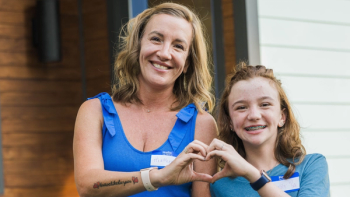
Diagnosed with leukemia at 8 years old, Harper feared that losing her hair would change who she was. She reflects on body image, confidence and finding a sense of herself during cancer treatment.
Dr. Doured Daghistani discusses how childhood cancer treatment, survivorship care and immunotherapy have evolved this Childhood Cancer Awareness Month.
In honor of Childhood Cancer Awareness Month, CURE spoke with Dr. Doured Daghistani, a pediatric hematologist-oncologist and medical director of pediatric hematology-oncology at Baptist Health Herbert Wertheim Cancer Institute, about how far treatment has come, what families should know after a diagnosis and where the field is headed next.
This transcript has been edited for clarity and length.
"Children with cancer are highly curable — that's the first thing families need to know. You're shocked because your child has cancer, but in the long run, 8 to 9 out of 10 children I diagnose with cancer become long-term survivors. I always tell parents, it's a glass half-empty or half-full situation. You can look at it as half-empty: 'My God, my kid has cancer, my kid's going to die.' Or you can look at it as half-full: 'My kid has cancer, but thank God we have treatment, and thank God 80% to 90% of kids with cancer are long-term survivors.'"
"I started working in the early '80s at University of Miami Jackson Memorial Hospital. The most common cancer in pediatric oncology is acute leukemia — about 5,000 to 6,000 kids a year in this country are diagnosed with it, and there are two types, ALL and AML. ALL is the more treatable type. Back then, I'd sit with a family and say, 'We have good treatment, and there's a 60% to 70% chance your child will be cured.' That was 1984.
I go back further, to 1965, when I was 7 years old. I saw a movie where a doctor sat with a family and said, 'I'm sorry, I can't offer anything. You have six months to enjoy your child.' Fast forward to today, I sit with the parents of my patients and tell them their child's chance of surviving is above 95%. That's amazing."
"In the '80s and '90s, and even up into the 2000s, all of us in pediatric oncology were focused on curing the children — increasing chemotherapy, beefing up the chemo, just trying to see what was going to happen. Then the pendulum swung to the other side. Today, about 1 in 1,000 teenagers turning 18 is a long-term survivor of childhood cancer. And now we're finding that a lot of these kids carry anxiety into adulthood. A significant number, maybe 20% to 30%, have issues with heart attack, with stroke, as they get older. Maybe they don't live a normal lifespan.
They don't have the same quality of life that you and I have. So right now, for the cancers we're already curing a lot of children with, like ALL, where we're at 95%, we're looking into fine-tuning the amount of chemotherapy. I call it poison. We want to see if we can keep these kids surviving without giving them all these drugs that hurt their life once they reach adulthood. Survivorship is a big thing in pediatric oncology right now, because we're seeing all the things we did to these kids show up once they're adults. But I think the future is bright."
"Immunotherapy, at least for now, doesn't have the same side effects we see with regular chemotherapy, and we're happy about that — although we don't know yet what the long-term effects might look like five or 10 years down the road. With regular chemo, everyone can tell a child has cancer because they lose their hair. With immunotherapy, that's not necessarily the case, and I see that as a positive. ALL survival in children is around 95% now, and part of that is immunotherapy.
One of the drugs we tried between 2010 and 2015 has become a backbone of treatment for newly diagnosed ALL because it improved survival. Immunotherapy, targeted therapy and CAR-T cell therapy all have a good role to play, especially for the one or two children out of 10 who don't survive their cancer. We have something called DIPG, a brain tumor with essentially no survivors. We're hoping these new tools help us not only improve survival where we've already made progress, but make these deadliest cancers less deadly than they are now."
"A lot. Pediatric oncology is different from adult oncology. In adult oncology, you might just have the patient, maybe a spouse. But when a child has cancer, you have two parents, four grandparents, and three or four siblings, and everyone is affected. I tell families, 'You're going through a tornado right now, and we're going to hold your hand through it.' At Baptist Health Herbert Wertheim Cancer Institute, we have what we call the pediatric oncology support team.
The doctor is the captain of the ship, but the doctor is only about 20% of the force. We have nurses, child life specialists, social workers, nurse navigators — and now palliative care specialists involved from the beginning, too, not just for the last few months of life, but for symptom management from day one. You have four or five layers of support, all part of the team from the day of diagnosis, and they all play as important a role as I do."
With Childhood Cancer Awareness Month, I want people to know we still lose 1 to 2 out of every 10 children with cancer. We're still working to improve quality of life for our long-term survivors. Anybody who can get involved in supporting research or a cancer institute, please do. It's worth it.”
For more news on cancer updates, research and education,