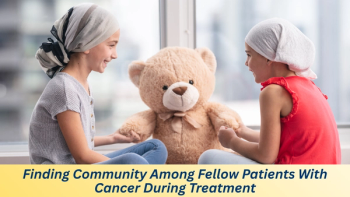
A cancer survivor reflects on losing her hair during chemotherapy, the emotional impact of hair loss and what growing it back taught her about healing, identity and life.

Bradford Aldrich, RN, of Brigham and Women's Hospital, creates moments of joy and connection for cancer patients through small gestures and a journal project that lets patients heal one another.
I am honored to nominate Brad for the Extraordinary Healer Award. Although Brad has been an oncology nurse for just over two and a half years, his presence, instinct and compassion suggest a vocational calling that has been quietly forming for decades. Each time I think I've seen the full depth of his practice, he reveals yet another way he heals, often in moments so human that they linger long after the shift has ended.
In the early years of nursing, it is common to see nurses deeply focused on mastering skills and time management. Brad does all of this exceptionally well. What sets him apart, however, is that he never allows the demands of practice to eclipse the personhood of his patients. He sees them not simply as individuals undergoing treatment, but as whole people living meaningful lives alongside their diagnoses.
Early in Brad's tenure, another nurse emailed me to share an experience that perfectly captures this. During his lunch break, Brad walked to a nearby grocery store to buy strawberry mochi for a patient who had been hospitalized for nearly two weeks. The patient had mentioned it as a craving, a small comfort during an emotionally and physically taxing course of care. Brad understood that honoring that craving was about far more than food. It was about normalcy and being seen and heard. He took the time to do so quietly, without expectation or recognition, simply because it mattered to his patient.
This instinct to preserve joy and humanity surfaces again and again in Brad's care. While caring for a patient from Brazil who had never experienced Halloween as a child, Brad recognized her sadness about missing the holiday while hospitalized. He purchased Halloween candy, not just for her but for the entire unit, so she could experience a tradition she had never known. It was a simple gesture, but one that reframed a hospital stay. Brad consistently reminds us that patients are people first, deserving of joy even during illness.
The impact of his care is deeply felt by those he serves. Over the summer, I received a handwritten letter from a patient who described how, during a prolonged hospitalization, Brad formed a genuine friendship with her. He encouraged her to build strength by walking together day after day. After weeks confined to one room, Brad took her by wheelchair to see the lobby and other areas of the hospital, an experience that profoundly lifted her spirits. On the day of her discharge, Brad came in on his day off simply to say goodbye. She wrote that Brigham and Women's Hospital was "very fortunate" to have him on staff, and that his care was marked by unwavering compassion and presence.
Perhaps the most extraordinary example of Brad's healing extends beyond individual encounters and into something he has created for the collective patient experience. Brad purchased a beautiful leather-bound journal and began a quiet tradition: Each week, he invites at least one patient to write in it for another patient.
He asks them two questions:
Week after week, patients contribute reflections filled with honesty, hope, realism and resilience. These entries speak of love, breathwork, fear, courage, gratitude and perseverance, with patients offering each other comfort and connection across diagnoses and timelines. Through this simple but profound act, Brad has created a living testament that has allowed patients to heal one another in ways medicine alone cannot facilitate.
What makes Brad's care even more remarkable is his humility. I rarely hear about these acts directly from him; instead, I learn about them through other nurses, patients, or occasionally by noticing something and asking, "Hey, what is this?" Whether it's a small gesture like bringing a favorite treat, orchestrating a special experience for a patient or initiating the journal project, he does these things quietly, without expectation of recognition or praise. His focus is entirely on the person he is caring for, not on the accolades he might receive.
He is a steady, uplifting force on the unit, someone who has never let a teammate or patient down, even when carrying the emotional weight of oncology nursing himself. I met with Brad recently after seeing that he had had a series of very challenging shifts. He is a true empath, deeply attuned to the suffering around him. And yet, in that same conversation, he said something that perfectly defines his calling: "No matter how hard the days are, I know I was meant to be an inpatient nurse."
Brad does not simply deliver care; he restores humanity, fosters connection and creates meaning in the most vulnerable moments of life. He heals with his hands, his presence, his creativity and his heart. For these reasons, and so many quiet moments that I have yet to learn about, Brad is profoundly deserving of the Extraordinary Healer Award.
For more news on cancer updates, research and education,