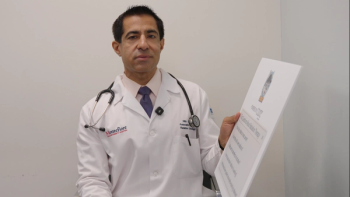
Dr. Nitin Ohri explains how radiation treats cancer, how often treatment is needed, common side effects and how to tell if radiation is working.
Leslie Waltke demonstrates gentle trunk rotations to help improve mobility in the lower and upper spine. Learn how to safely perform this exercise at home.
Keeping your body moving during and after cancer treatment can be an important part of maintaining strength, flexibility and mobility. In this week’s exercise video, oncology physical therapist Leslie Waltke demonstrates a simple movement called trunk rotations, which can help gently mobilize the lumbar spine (lower back) and thoracic spine (upper and middle back).
The exercise can be done on a bed, on the floor or on an exercise mat, making it an easy movement to incorporate into your daily routine. Leslie notes that it can be especially convenient in the morning, when you first wake up, or before bed if discomfort or stiffness makes it difficult to get comfortable.
To begin, find a comfortable surface where you can lie flat on your back.
1. Lie on your back.
Start by lying flat with your back supported by the bed, floor or mat.
2. Bend your knees.
Bring both knees up so your feet are flat on the surface. Try to keep your knees together and bring your feet relatively close to your body. However, if that position is uncomfortable or your knees prevent you from bringing your feet closer, simply place your feet and knees wherever feels comfortable.
3. Position your arms.
Extend your arms out to the sides. Your arms can be positioned wherever feels comfortable and supportive for you.
4. Slowly rotate your knees to one side.
Keeping your knees together, gently lower them toward the right side. As you do this, you may feel a stretch through your left hip while also creating gentle movement through your spine.
5. Pause and breathe.
Once you have moved as far as feels comfortable, pause for approximately one to three seconds. You do not need to force your knees toward the floor. The goal is gentle, comfortable movement.
6. Rotate to the opposite side.
Slowly bring your knees back toward the center and then rotate them toward the left side. Again, move only as far as you comfortably can.
7. Continue alternating sides.
Move slowly from one side to the other, allowing your trunk and spine to gently rotate with the movement. Leslie explains that hearing some cracking or popping is not uncommon, but the exercise should not cause pain.
If you want a little more rotation, Leslie demonstrates bringing the top leg slightly upward while turning to the side. This can allow for additional rotation through the spine.
The important thing is not how far you can rotate. Instead, focus on moving through a comfortable range of motion without forcing the movement.
Leslie recommends performing 5 to 10 repetitions, alternating from side to side. Because this is a gentle mobility exercise, it can also be incorporated into your routine regularly, including on a daily basis if it feels comfortable for you.
One benefit of trunk rotations is that they require very little equipment. You can perform them on your bed when you wake up in the morning, making them an easy way to gently get your spine moving before starting your day. They can also be useful as part of a bedtime routine.
As with any exercise, comfort is important. Leslie emphasizes that you should not experience pain while performing trunk rotations. You can adjust the position of your feet, knees and arms to find a variation that works best for your body.
The goal is gentle mobility—not forcing your spine into a deeper stretch. Move slowly, stay within a comfortable range and stop if an exercise causes pain or feels unsafe.
If you are living with or beyond cancer and are unsure whether this exercise is appropriate for you, consider speaking with your health care team or a physical therapist before adding it to your routine.
For more news on cancer updates, research and education,