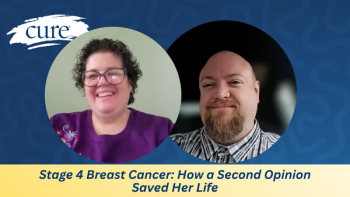
Diagnosed with stage 4 breast cancer weeks after giving birth, Eileen Carter explains why getting a second opinion changed the course of her care.
Experts say resilience helps patients with cancer adjust emotionally and physically after treatment, easing fear of recurrence and supporting long-term recovery.
Resilience plays a key role in helping patients adjust after cancer treatment ends, according to Frank Penedo, professor of psychology and medicine and associate director for population sciences at the Sylvester Comprehensive Cancer Center.
Penedo says resilience helps patients with cancer navigate lingering physical and emotional challenges, including fear of recurrence and changes in daily functioning, social roles and work life. He explains that patients bring their life experiences and strengths into survivorship, and resilience can help them shift perspective and find meaning after cancer. Researchers are also studying resilience-based interventions to support lymphoma survivors.
What are some of the most common challenges survivors face once treatment ends, and why is resilience such an important focus during the stage of recovery?
Resilience is critically important for a variety of reasons. Once treatment ends, patients with cancer — including lymphoma survivors — have gone through diagnosis, treatment planning and coordination, and the uncertainty and anxiety of wondering, “Is the treatment going to work? Am I going to survive this?” Treatment-related side effects, especially physical ones, can persist well beyond treatment in some cases, sometimes even five to 10 years. Emotional symptoms and concerns can persist as well because even for patients who do very well and respond well to treatment, there is always the fear of recurrence.
There is also limited capacity for many survivors in physical functioning, and social roles often must be adjusted. Work roles may also change. Many different changes can take place. It is a new normal for patients.
If we look at the work that we’ve been doing in the field over the past several decades, it has become very clear that the transition from primary treatment into survivorship is critically important for a variety of reasons. Traditionally, patients received a lot of attention at diagnosis, during treatment planning and during treatment, but not as much after treatment ends, other than being told, “This is your follow-up plan. These are the tests you need to have. This is your schedule so we can monitor your disease.”
Over the past several decades, we have made progress in understanding the tools and mechanisms that can help survivors cope and adjust better. This ranges from stress management to lifestyle and behavioral management.
More recently — meaning in the past 10 to 20 years — we have also looked at how individuals can be very resilient. Cancer doesn’t happen in a vacuum. Patients bring their life experiences, their challenges and their strengths. For many patients, resiliency is a strength or a component of character that helps them move through the challenges they face.
Resiliency is also related to the concept of benefit finding, which gained popularity in the late 1990s and early 2000s, especially among breast cancer survivors. Patients sometimes reported that despite cancer being a terrible and stressful experience, they were able to shift and reframe and find some benefit — whether that was a greater appreciation for life, stronger appreciation for family, becoming more spiritual or picking up a new hobby. That is a component of resiliency: learning how to adjust and pivot, and putting energy into turning something devastating into something that can have some positive meaning.
And this is a resiliency study with Massachusetts General Hospital as the lead institution. We are looking at a resiliency intervention for lymphoma survivors to help optimize these resilient processes.
Transcript has been edited for clarity and conciseness.
For more news on cancer updates, research and education,