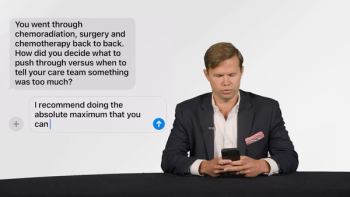
In the latest installment of CURE's "Text a Survivor" series, Brad Moore answers some of the most common questions people have about living with and beyond a colorectal cancer diagnosis.
Dr. Benjamin Jon Golas explains that surgery, chemotherapy and radiation form the foundation of curative-intent treatment for patients with pancreas cancer.
Dr. Benjamin Jon Golas of Hackensack Meridian Health discussed the main strategies for treating pancreas cancer, focusing on surgery, chemotherapy, and radiation.
Treatment for pancreas cancer generally rests on three pillars. Surgery to remove the tumor is a key option, with the type of operation varying based on the tumor’s location in the pancreas. Systemic chemotherapy — delivered intravenously or sometimes as pills — targets cancer cells throughout the body and is another central component. Radiation therapy can also be used in certain cases to target tumors more precisely.
For patients with tumors that are resectable or non-metastatic, according to Golas, most receive a combination of surgery and chemotherapy, sometimes in a specific sequence depending on the individual. Radiation may be added in select situations. These approaches together form the foundation of curative-intent treatment for pancreas cancer.
What are some of the current treatment options that are available that you want to highlight, that you think are important?
I would say the treatment for pancreas cancer, really, there's three pillars on which treatment is based. One is certainly surgical resection — so surgery to remove the tumor in the pancreas — and the operations are a little bit different depending on the location in the pancreas. Certainly systemic chemotherapy — so, medications or drugs that are designed to kill pancreatic cancer cells that can be delivered intravenously and sometimes by pill form — is a huge, huge pillar of treating pancreas cancer. And things like radiation, which is something where we can apply in different forms to pancreatic tumors, certainly plays a role, I would say, for most patients who are, depending on the stage — but patients who have a tumor that's technically resectable or non-metastatic, meaning it's limited to the pancreas, the majority of those patients, honestly, will usually receive surgery and chemotherapy.
I think that combination of treatment, and depending on the sequence — the sequence sort of depends on the patient — those two things are really sort of the hallmark of curative-intent treatment for pancreas cancer. And certainly radiation, I think, plays a role in select cases. So those are really the major hallmarks on which we build our treatment platform for pancreas cancer.
Transcript has been edited for clarity and conciseness.
For more news on cancer updates, research and education,