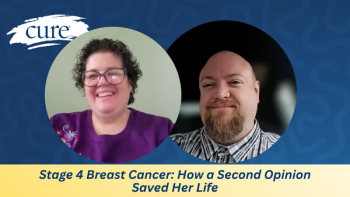
Diagnosed with stage 4 breast cancer weeks after giving birth, Eileen Carter explains why getting a second opinion changed the course of her care.

Tukysa may be a patient-friendly option as a first line maintenance treatment for HER2-positive breast cancer, as Dr. Erika Hamilton explained.
Tukysa (tucatinib) may represent a new patient-friendly option as a first line maintenance treatment possibility for patients with HER2-positive breast cancer, as an expert recently explained in an interview with CURE.
Dr. Erika Hamilton sat down for an
Hamilton is the Chief Development Officer, Late Phase, as well as Director, Breast Cancer Research, at the Sarah Cannon Research Institute (SCRI). She spoke with CURE’s editor-in-chief, Dr. Joshua K. Sabari, an Assistant Professor in the Department of Medicine at NYU Grossman School of Medicine and Director of High Reliability Organization Initiatives at NYU Langone’s Perlmutter Cancer Center.
To watch Hamilton and Sabari’s full conversation, be sure to visit
Your study,HER2CLIMB-05 , is very exciting. Let’s discuss [Tukysa], a HER2 tyrosine kinase inhibitor, really an exciting therapy. Can you tell us about that data and how it impacts patients’ care?
[Tukysa] is an
And what this trial, HER2CLIMB-05, asked is the benefit of moving it up into an earlier setting. So not second line, which is where the current FDA approval is, but in the first line maintenance strategy. Now this idea of maintenance in the first line is honestly a little bit new to us. Our first data we got about a maintenance was from the PATINA study, which was actually San Antonio Breast Cancer Symposium 2024. It is still not FDA approved. … But that showed the addition of [Ibrance (palbociclib)] for patients that are HER2-positive and ER-positive to endocrine therapy plus [Herceptin] and [Perjeta], once the chemo taxane was dropped out, was beneficial. So that really introduced this whole idea of maintenance, because sometimes patients can be on this three, four, five years. I have a patient that's continuing to get [Herceptin] that has been on it for six years now.
So, this looked at not only ER-positive, but also ER-negative disease — with, of course, everyone having HER2-positive disease — and asked that same question: After four to eight cycles of taxane, induction therapy, when you drop your taxane out, does adding [Tukysa], with or without endocrine therapy if they're ER positive, benefit? And we found that it did.
The hazard ratio was 0.725, the benefit was almost nine months in PFS, so 16 months up to over 24 months. I think this is meaningful for patients. It was nice because it included both patients who were ER-positive and ER-negative. And so, I think that's at the FDA looking for approval too, but we're likely to have two maintenance strategies where patients conceivably can drop out their cytotoxic chemo and be on targeted therapy only in this first line setting, which I think is very patient friendly
Transcript has been edited for clarity and conciseness.
For more news on cancer updates, research and education, don’t forget to