



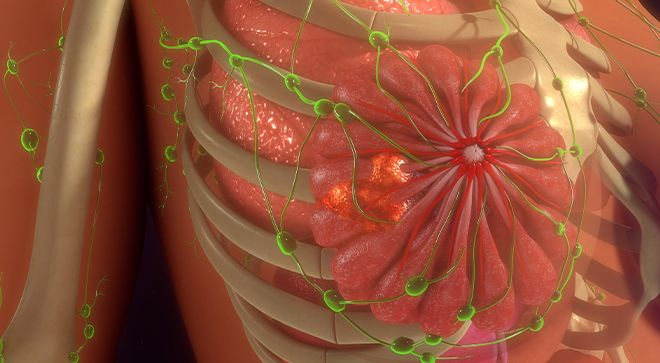

On social media, CURE® recently asked its readers to share their thoughts on the month of “Pinktober”.
On social media, CURE® recently asked its readers to share their thoughts on the month of “Pinktober”.

Every October, pink ribbons pop up as a symbol of breast cancer awareness. This year, marketing strategies have changed due to the COVID-19 pandemic. One survivor offers some insight on those changes.
Remember, knowledge is power. The more information you have about your cancer, the less power it has over you.

Findings from a randomized phase 3 study showed that adding neoadjuvant Tecentriq to a chemotherapy regimen of Abraxane, Adriamycin and Cytoxan in patients with stage 2 or 3 triple-negative breast cancer significantly improved pathologic complete responses, compared with placebo plus chemotherapy.

The greatest obstacle facing men with breast cancer may be … ourselves.

“This randomized clinical trial found that compared with the conventional anthracycline and docetaxel regimen, the paclitaxel-plus-carboplatin regimen may be an alternative adjuvant chemotherapy strategy for patients with operable TNBC,” the authors wrote.

“In the field of triple-negative breast cancer, we're beginning to see some remarkable advances, mostly centering around the three paradigms that have become so attractive for the treatment of cancer: immunotherapy, targeted biologics and antibody-drug conjugates,” Dr. Howard A. “Skip” Burris, III said in an interview.

The Food and Drug Administration’s warning comes weeks after Genentech, the manufacturer of Tecentriq, issued a press release noting that the IMpassion131 trial failed to meet its primary endpoint of improving progression-free survival in patients with triple-negative breast cancer.
It seems acceptable in our world to grieve the loss of a loved one, but unheard of to grieve the loss of body parts.

Breast cancer makes you wiser and more mature, but it also opens your heart to see that love is around you. It has showed me something that I initially did not want to accept, which was to love myself.

Eryaspase, a novel drug candidate, is being evaluated in patients with second-line metastatic pancreatic cancer and those with metastatic triple-negative breast cancer.
Through a Facebook poll, I discovered that some women found talking about post-cancer sex easy, but for others, including myself, it was a challenge. And I wondered why that was the case.

We answer your patient navigation questions at the 4th Annual Patient Navigation Town Hall "Empowering and Mobilizing Our Patient Navigation Workforce".
At the 4th Annual Patient Navigation Town Hall "Empowering and Mobilizing Our Patient Navigation Workforce", experts discuss how navigators can mobilize for equity in their field.
At the 4th Annual Patient Navigation Town Hall "Empowering and Mobilizing Our Patient Navigation Workforce", we provide you insight into how to get properly certified as a patient or nurse navigator.
The importance of nurse navigation and patient navigation through the COVID-19 pandemic.
Patient navigators are the vaunted “healthcare emissaries” for patients with breast cancer and can help navigate their journey a great deal. In this conversation from the Susan G. Komen Greater New York City “Empowering and Mobilizing Our Patient Navigation Workforce” virtual conference experts highlight the results of a survey of patient navigators.

An 11-year survivor of inflammatory breast cancer details how even though she considers herself one of the lucky ones, the awareness that “as far as we know” could change in one blinding moment still haunts her.

From a new survey showing that more than one-third of Americans missed cancer screenings due to COVID-19 fears to a couple overcoming both COVID-19 and breast cancer, here’s what’s making the headlines in the cancer space this week.
One cancer survivor emphatically disagrees with the notion that cancer is now a “chronic” condition.

“Laughter is the best medicine” is a principle that CURE Voices contributor Khevin Barnes takes, well, seriously. In this edition of CURE Community Vlogs, Khevin takes a minute to discuss how laughter can help men with breast cancer find a new outlook on their diagnosis.
Individuals who were screened for hereditary cancer risk in the past might benefit from getting tested again using today’s more sophisticated panels.
A celebrity death reveals how little we really know about breast cancer.
A survivor of male breast cancer goes through what he wishes he knew before a breast cancer diagnosis.
Dr. Julia Rani Nangia explains how certain chemotherapy types and sequencing have different impacts on hair retention for patients with breast cancer.