Now Playing
Get expert answers to the top pancreatic cancer questions, including symptoms, surgery, new treatments, hereditary risk and early diagnosis.
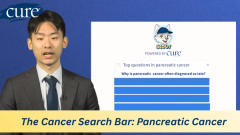
Navigating a cancer diagnosis often begins with a simple online search. The new Cancer Search Bar series from CURE brings those commonly searched questions directly to oncology experts, providing reliable, physician-backed answers to the topics patients and caregivers want to understand most.
In this episode, Dr. Jonathan Lee, chief hematology/oncology fellow at New York-Presbyterian Weill Cornell Medicine and incoming gastrointestinal oncology faculty member at Stanford University, answers five of the most frequently asked questions about pancreatic cancer, covering diagnosis, treatment, surgery and hereditary risk.
According to Dr. Lee, pancreatic cancer is typically discovered in one of two ways: through screening or after symptoms develop. Unlike some cancers, there is no routine screening for most people, and the pancreas is located deep within the body, surrounded by major blood vessels and vital organs.
Because tumors can grow silently before causing symptoms, they may already be involving nearby structures by the time they are detected, making pancreatic cancer more likely to be diagnosed at a later stage.
Dr. Lee says the answer is yes.
Some pancreatic abnormalities are discovered incidentally during imaging performed for unrelated reasons. When these lesions are caught early enough and can be completely removed with surgery, patients may be cured.
Depending on the tumor's location, surgery may involve a Whipple procedure or a distal pancreatectomy, both of which are designed to remove the cancer before it spreads.
Not every pancreatic cancer can be removed surgically.
Dr. Lee explains that surgeons carefully evaluate high-quality CT scans and MRIs to determine how close a tumor is to nearby blood vessels and organs. If there is enough separation — known as a safe surgical plane — between the tumor and these critical structures, the cancer is considered resectable and surgery may be recommended.
Dr. Lee says this is one of the most exciting times in pancreatic cancer research in decades.
For many years, chemotherapy was the primary treatment option. However, new targeted therapies are beginning to change the landscape.
He highlights results presented at the 2026 American Society of Clinical Oncology (ASCO) Annual Meeting from the RASolute-302 clinical trial, which evaluated the investigational drug diraxon RAS(ON) inhibitor. The findings suggest that therapies targeting mutations once considered "undruggable" may offer promising new options for patients.
Dr. Lee notes that these advances could pave the way for future treatment combinations involving targeted therapies and immunotherapy.
Yes. Dr. Lee explains that inherited cancer syndromes, including Lynch syndrome, can increase a person's risk of developing pancreatic cancer.
For patients whose tumors are found to carry inherited DNA repair gene mutations, genetic counseling and testing may also be recommended for close family members. Screening recommendations are individualized but often begin around age 50 or approximately 10 years before the age at which the youngest affected relative was diagnosed.
Patients should discuss their personal and family history with their oncology team to determine whether genetic testing and surveillance are appropriate.
For more news on cancer updates, research and education,