Some patients with lymphoma show no detectable cancer by day 8 of treatment, and a lymphoma specialist explains how early testing could guide care.
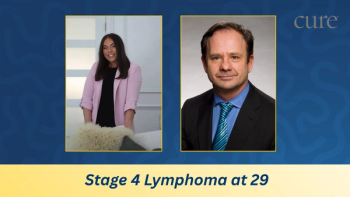
14 years after a rare lymphoma diagnosis, Edward Miskie answers real questions on survivorship, caregiving and life after cancer treatment.
Edward Miskie was diagnosed with a rare and aggressive form of non-Hodgkin lymphoma, Burkitt-like B cell lymphoma, in 2011. Fourteen years later, he joined CURE for its Text a Survivor series, answering questions submitted by patients, survivors and caregivers on what it really means to live with and beyond a cancer diagnosis.
The conversation has been edited for clarity.
Miskie: I think at first I was like, oh my God, I’m going to die, and then I was more like, I don’t have time for this, and then it became, OK, how do I beat this. It'‘s kind of like the seven stages of grief, but let's call it the three stages of finding out.
My loved one was just diagnosed. What is the most important thing I can do for them right now?
This may feel a little antithetical to what you want to do, but I would say either ask them what they need, ask them what they want, or in some cases just leave them alone. It depends on your relationship with them. But as a cancer survivor, the one thing that I wanted in that moment was control, and asking or doing without asking takes away that control.
The thing that surprised me the most was how going back to the life that I had was nothing like what I thought it was going to be, because that life was no longer there. The hospital, doctors and nurses, not on purpose, kind of kick you to the curb, which is a good thing because it means you are cancer free. But everything has changed, life has moved on without you and that is no one’s fault. If I were to advise you on being prepared for that, I would say be ready to have everything feel different and be strong, because this might be the hardest part.
That everything on the other side of it was going to be a giant party. I knew chemotherapy, radiation and the stem cell transplant were going to be tough. But the assumption that you come out the other side cancer free and it‘s all just a party of gratitude was the biggest misconception I had, because it's not like that at all.
I don’t love using the word struggle. Everyone’s treatment is different, everyone’s outcome is different and everyone’s perspective on navigating treatment is different too. What I would tell you is to [try and] change your attitude and perspective toward what’s happening to you, and force yourself, [although it’s] very hard, to look at the bright side, make good memories and find ways to smile and laugh during treatment. I know it sounds cliché, but it really works. One of the things I remember most about my treatment is how much fun I had with my friends and family in and outside of the hospital room. It was a very dark time, but it had silver linings and sunshine woven through it.
I know it doesn’t feel this way right now, but everything is going to be OK. It’s OK to trust your instincts and yourself and to not necessarily listen to the people around you. Go with what feels best for you, with your doctor’s advisement and make sure you are good to yourself physically, mentally and emotionally.
Fear of recurrence long-term doesn’t go away –– fair warning –– but it does get better. In the beginning, every cut, scratch, bruise, cough or ache feels like cancer is inevitably coming back. Fourteen years out, I still have those feelings from time to time. Recently I sent myself to the emergency room to have something checked that I was worried was a recurrence. It wasn’t, and I was in absolute mania. But that doesn’t happen frequently, and when it does, even though it’s big, it’s manageable. All the feelings you’re feeling straight out of the gate will dilute, get better and eventually go away.
This goes back to playing the cancer card. You are absolutely allowed to ask for help. A lot of us are not good at asking for help, but it’s necessary for going through something as big and traumatic as cancer treatment. Feeling like a burden might be a natural response, but it’s necessary, and you should do it. I’m sorry to sound curt, but get over it. Ask for help. It’s OK.
For more news on cancer updates, research and education,